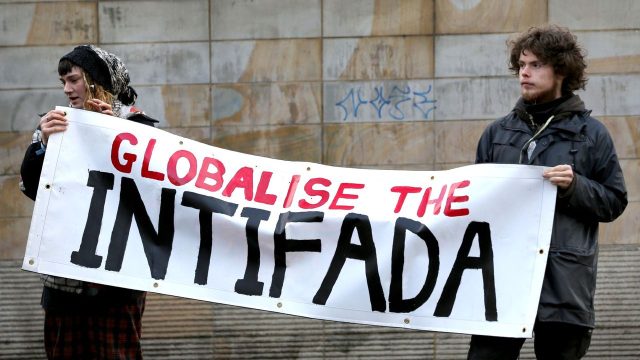
Police in London and Manchester will take a “more assertive” approach to protesters who call for intifada, according to a joint statement from the two forces following antisemitic attacks in Australia and in the UK. Officers have arrested two people for racially aggravated public order offences after they allegedly chanted “globalise the intifada” at a pro-Palestinian protest in London.
What is an intifada?
Intifada is an Arabic word derived from a verb meaning “to shake off”. It’s used to describe “two major uprisings” against the Israeli presence in the West Bank and Gaza Strip in 1987-1993 and 2000-2005, said the Institute for Middle East Understanding.
Both periods of intifada saw Palestinians participate in peaceful protest and acts of civil disobedience, but were also marked by violent clashes with the Israeli security forces and deadly terrorist attacks within Israel. More than 1,000 Israelis and about 5,000 Palestinians died in such incidents between the start of the first intifada in 1987 and the 2005 Sharm El Sheikh summit that brought the second intifada to an end.
How did ‘globalise the intifada’ become a rallying cry?
“Globalise the intifada” is a slogan that has been used to advocate for international support of Palestinian resistance against Israeli military occupation of Palestinian territories.
First popularised at solidarity rallies around the world during the second intifada, it has become a common rallying cry at pro-Palestine demonstrations since Israel launched its military operations in Gaza following the 7 October attacks.
The global intifada is the “‘shaking off’ of colonial dynamics of racism, violence, dehumanisation and division”, said Chloe Skinner for the Institute of Development Studies. The violence in Gaza and the West Bank is rooted in “global systems of power”, and so the struggle against them must be “globalised”.
Why do some people consider it antisemitic?
As the “most prominent expressions” of intifada have involved “violence”, said the American Jewish Committee, “globalising the intifada” is often understood to mean “encouraging violence” against Israelis and Jews more broadly, even if the “intent of the person saying this phrase may be different”.
It’s “helpful to possess a lexicon of what is typically intended” behind the “vocabularies” used in support of the Palestinian cause, said David Frum in The Atlantic. “Globalise the intifada means shooting or bombing people in Sydney, London, Paris, Toronto, Los Angeles and New York City”, as well as in Israel.
The BBC recently corrected an article on its website that defined intifada as “largely unarmed and popular”. After complaints, the corporation amended the article, saying that the word intifada was regarded by some as a “call for violence against Jewish people”.
But Palestine Solidarity Campaign director Ben Jamal said the Met Police and Greater Manchester Police joint statement marked “another low in the political repression of protest for Palestinian rights”. Intifada is about “uprising against injustice”, he said, and the “implication” that language used to “support the liberation of the Palestinian people” is “only open to interpretation” by pro-Israel groups is “deeply problematic”.
Police have arrested two people over controversial ‘globalise the intifada’ chants