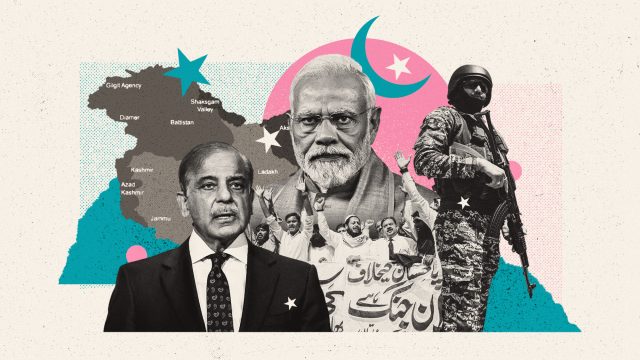
India and Pakistan inched closer to overt conflict last week after an attack in the Indian-administered Kashmir region left dozens dead and set the two nuclear-armed neighboring nations on the latest collision course in their decades of acrimonious relations. In the days since gunmen opened fire on tourists in Kashmir’s Anantnag district, India has threatened to withdraw from the treaty that provides water to the bulk of Pakistan, prompting that country to close its airspace to Indian flights. As both countries continue baring their teeth at one another, where might all this hostility lead?
What did the commentators say?
The “fast-rising tensions” between India and Pakistan have led to a “series of escalating tit-for-tat moves” since the terrorist attack, The Guardian said. As a result, the two nations have moved “closer to military confrontation.” The hostilities are “rekindling memories of February 2019 when a car suicide bombing in Kashmir brought the two countries to the verge of war.” The two nations have “unleashed a raft of measures” against one another in the last week, said Al Jazeera, and there have been “cross-border skirmishes” involving “small arms fire” across the India-Pakistan border. With “diplomatic, trade and travel links” in the region “already at a low ebb” since 2019, The Economist said, the actions taken in the past few days have been “largely symbolic.”
In particular, India’s threat to withdraw from the Indus Waters Treaty signifies a “rupture” with “huge symbolic and strategic weight,” The New York Times said. Within Pakistan, there is “growing concern” as various Indian figures “hint at the possibility of military strikes,” with some Pakistani analysts warning that the “current confrontation could intensify beyond the 2019 standoff.” While Pakistan has denied allegations that its government may have played a role in the Kashmir attack, the incident fits a “pattern of terrorist attacks occurring on Indian soil,” when the Pakistani military “feels excluded from the geopolitical conversation,” said Manjari Chatterjee Miller, a senior fellow for India, Pakistan, and South Asia at the Council on Foreign Relations. Given the Trump administration’s apparent closeness with India’s Prime Minister Narendra Modi, current events “could have given such an impetus.”
In Kashmir, “thousands have flocked to the streets” to protest the violence, while business owners “express concerns” over the commercial impact of the attacks on the “popular tourist destination during peak season,” CNN said. At the same time, several anti-Pakistan protests have “erupted” in various Indian cities, raising fears of “fueling anti-Kashmiri and anti-Muslim sentiment.”
What next?
For India, “military retaliation, at some point in the coming days, is a real possibility,” said South Asia analyst Michael Kugelman at Newsweek. The “scale and targeting” of the Kashmir attack make it “all but assured” that India will respond “with muscle.”
At the same time, New Delhi’s regional rivalry with Beijing and the proximity of all three nations make the shared border the “world’s only three-way nuclear junction,” said The Associated Press. With China’s support of Pakistan and the United States’ ongoing backing of India, any India-Pakistani conflict that starts as a bilateral engagement is “unlikely to stay strictly between them, as their strategic partners are likely to get involved.” Pakistan has “reinforced” its military forces ahead of an “imminent” action by India, said Pakistani Defense Minister Khawaja Muhammad Asif to Reuters. But the country will only turn to its nuclear arsenal if “there is a direct threat to our existence.”
Despite concerns of a wider regional conflict, China is thus far urging India and Pakistan to “exercise restraint,” and “meet each other halfway” with “dialogue and consultation” for the sake of “regional peace and stability,” said Foreign Ministry spokesperson Guo Jiakun at Deutsche Welle.
The U.S., meanwhile, has met with Indian and Pakistani officials at “multiple levels” of government, and “encourages all parties to work together towards a responsible resolution,” a state department spokesperson said to Reuters. India and Pakistan “work themselves into a frenzy every few years,” said Husain Haqqani, a former Pakistan ambassador to the U.S, to Reuters. “This time, there is no U.S. interest in calming things down.”
As the two nuclear-armed neighbors rattle their sabers in the wake of a terrorist attack on the contested Kashmir region, experts worry that the worst might be yet to come