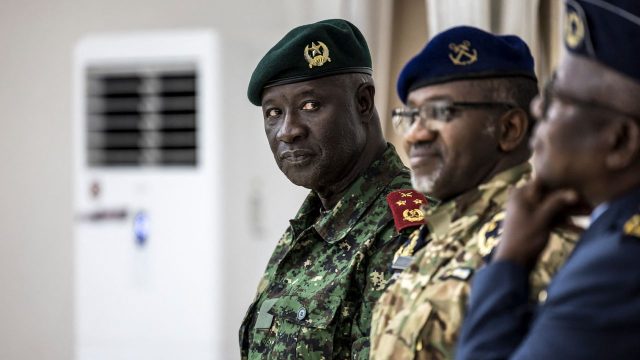
Last week’s military takeover in Guinea-Bissau is the latest in a series of coups that has engulfed west Africa in recent years. Almost all have taken place in the Sahel, the semi-arid belt below the Sahara that bisects the continent.
The latest coup in Guinea-Bissau “doesn’t follow the regional script led by Burkina Faso, Mali and Niger”, said Tomi Oladipo on Semafor. And each of the coups in west Africa has had “unique triggers”, said researcher Salah Ben Hammou on The Conversation. But neither are they isolated events: this is a “coup cascade” in the Sahel.
How did it begin?
When Libya’s Gaddafi regime collapsed in 2011, an “abundance of weaponry” was looted and spread across the Sahel, said world news newsletter Proximities. Members of Mali’s Tuareg group who had fought in Libya returned with fighting experience, seeking an autonomous state in northern Mali. The rebels aligned themselves with multiple Islamist jihadist groups and began capturing territory.
The conflict quickly spread from Mali into neighbouring Burkina Faso and Niger. Their tri-border region in the western Sahel, known as the Liptako-Gourma, “allows the biggest of the rebel groups to engage in a war with three governments at once”.
When Malian soldiers ousted Mali’s President Ibrahim Boubacar Keïta in 2020, it “marked the beginning of a broader wave of military takeovers”, said The Conversation. Soldiers “toppled governments” in Chad and Guinea in 2021, Burkina Faso in 2022 (twice), and Gabon and Niger in 2023. At the eastern end of the Sahel, Sudan “descended into a devastating civil war” after its coup in 2021.
What connects the coups?
Analysts point to weak governance and corruption, growing Islamist terrorist insurgencies and the destabilising effects of the climate crisis, as well as rising anti-Western (particularly French) sentiment, fanned by Russia.
Military governments in the former French colonies Mali, Burkina Faso and Niger have “played up” this populist “resentment of France” and accusations of “neocolonial tendencies”, said Al Jazeera. They pressured Western forces to leave and have turned towards Russia for “strategic support”. Hundreds of mercenaries from the Wagner group (“rebranded as Africa Corps, and operating as a part of the Russian government”) are now “on the front lines”.
“Sahelian countries are in danger of swapping one kind of imperialism for another”, said the Financial Times. In Mali, Russian mercenaries promised protection for the military junta and “defeat of a dogged Islamist insurgency”. Today, with al-Qaida-affiliated fighters encircling the capital with a “crushing fuel blockade”, and with talk of another coup, “it is clear the Russians have brought neither peace nor stability”.
Experts also blame the Economic Community of West African States (Ecowas). They say the regional bloc “was not firm enough after the first coup in Mali and did not immediately react with punishment strong enough to deter others”, said Al Jazeera. “The lack of coherent and consistent response by Ecowas emboldened the coup-makers to act with impunity,” Festus Kofi Aubyn, a Ghana-based researcher with the West Africa Network for Peacebuilding, told the news platform.
What happens next?
“Almost without the world noticing, the Sahel has become the epicentre of global terrorism,” said the Financial Times. More than half of all terrorism-related deaths last year occurred there, according to the Global Terrorism Index. “The fear among more prosperous coastal states is that militant Islam will spread south.”
Countries including Benin, Ivory Coast, Senegal and Ghana are “rightly jittery”. Nigeria, also troubled by Islamist militants, is also “fearful of infection” from neighbouring Niger. In Burkina Faso, “the regime itself is not yet teetering”, but the government “controls less than half the country’s territory”, with an al-Qaida affiliated group controlling “much of the rest”.
“The final lesson is clear”, said Hammou on The Conversation. When coups are “treated as isolated rather than interconnected”, and when the international community offers responses that are “weak, delayed or inconsistent”, more will likely follow.
Guinea-Bissau takeover is the latest in the Sahel region, which has quietly become global epicentre of terrorism