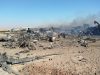

The movies tend to depict the post-apocalyptic world as a wasteland, with tumbleweed blowing across the cold, hard ground and people scrounging for scraps to survive. Think of the cult movie Mad Max, the original starring Mel Gibson or even the recently re-imagined one starring Tom Hardy and Charlize Theron. In the post-apocalyptic world, all economies have crashed and the fight for survival is a battle to control energy or fuel.
We were all made to believe that if fuel became too expensive then the world markets would crash and someone somewhere would flip that red switch and bomb the entire world. Too expensive usually means breaching the US$100 mark. The invasion of Iran by the United States and Israel, with the complicity of Gulf states such as the United Arab Emirates, Qatar and Saudi Arabia and the subsequent shutting down of the Strait of Hormuz to those countries and their allies by Iran, has obliterated the US$100 mark.
Energy economics experts are predicting that if the war goes on for another one or two months, then US$150 or even US$200 is not far off!
In our imagination it is a straight line — a war between erstwhile enemies, inflated chauvinistic egos, high oil price, economies crashing, especially the New York Stock Exchange and the petrodollar going bust, nuclear bombing seems like the only option and then we start killing each other over meagre resources just to survive.
Many wonder how far away World War III is. When do China and Russia jump in on the side of Iran? Will Israel use that nuclear bomb they are rumoured to have?
For many of us, the war against Iran by the US-Israeli axis is the largest and most consequential of our lifetimes.
None of the multi-country wars like the invasions of Iraq or Afghanistan have impacted the world like this one has. It is not just oil but also fertiliser so that means agriculture and therefore food supply, as well as liquified natural gas (LNG) supply, are also in jeopardy.
The war against Iran signifies that we have distinctly left behind the post-World War II consensus of faux pas multilateral governance with one major superpower that is constantly threatened by an upstart such as the erstwhile Soviet Union (Russia) or China and we have now entered the Age of Empire.
This age is different to the post-World War II Cold War between the Soviet Union and the United States, or the post-2000 world of globalisation with open trade routes and the battle to be the supreme economic and military hegemonic power between China and the US-led West.
The chief difference is that in the empire age it is accepted that there are other empires than your own and the trick is not to want to rule the world but to be the strongest of all the empires.
The catalyst for the age is that the Iranian war means we have come to the end of a world where economies could be fuelled by cheap oil prices. The price of oil will not go back to US$50 or US$60; it will always be close to or above US$100.
Neither should you be fooled that electric cars and the so-called green economy of solar panels, wind farms and ocean turbines will be able to bridge the gap left behind by inexpensive fossil fuels.
Industrial manufacturing and even the artificial intelligence economies require large amounts of energy and fresh water.
American Senator Warren Johnson said in 1929: “The first casualty when war comes is truth.” So too it is important that we take all the information we get from the Iranian war with a pinch of salt. Whoever you listen to will be telling you how they are winning the war.
American President Donald Trump’s Truth Social posts and press conferences have become legendary. It is remarkably similar to his press conferences during the Covid-19 pandemic lockdown, where he felt the urge to be a cheerleader and even bend the truth so that things do not seem too dire.
So, although we cannot claim to know who is exactly winning or losing in this war, it is becoming abundantly obvious that the United States and Israeli objectives of toppling the Iranian government and theocratic rulers will most probably not be met.
However, them not meeting their objectives does not mean that Iran has won the war. The actual biggest losers are most probably China and Europe. Our focus will be on China.
The Chinese economy is wholly dependent on cheap fuel and its supply from Venezuela and Iran has been severely affected.
Although Iran still has control over the Strait of Hormuz and Chinese oil vessels can safely travel through it, this does not extend to Qatari LNG, which the Chinese really need as well.
The United States, especially with the “Donroe Doctrine” has essentially claimed the Western Hemisphere as its own. This hemisphere does not need oil, fertiliser, LNG or any other resource (including rare earths) — it is totally self-sufficient.
Iran shall continue to be placed under siege. And like how Germany and much of Western Europe were dependent on Russian gas, once the pipeline was destroyed, an alternative plan had to be realised.
Therefore, we should not expect the oil-producing Gulf states to remain forever dependent on the Strait of Hormuz for their oil to be transported.
There must be plans to build a pipeline from those fields to Israel and most probably the occupied territories of Palestine and Southern Lebanon. China and Russia had begun constructing a pipeline from Iran; however, with the war currently taking place it is very difficult for that work to continue.
This is the plan. The United States no longer feels the urge to rule the world as its largest superpower, rather to extract tithes from those who wish or are forced to remain within its empire, like Europe. It is essentially the Trade Federation under the leadership of Emperor Palpatine in Star Wars.
So, what should countries like South Africa do as we enter the Age of Empire? We are not large enough to be an empire and neither do we have the social cohesion like Iran to withstand a consistent attack from any one of the empires. So do we choose which empire to sell out to?
The South African government has navigated this period remarkably well. It has not capitulated to any of the stronger blocs, whilst retaining its dignity and independent views.
But in an Age of Empire where multilateral bodies and their protocols mean very little, this will not be good enough.
We know as Africans that “when the elephants fight, the grass suffers” and we cannot stand by idly waiting to be trampled upon. It is imperative that South Africa, Nigeria, Brazil, Mexico and Indonesia begin talking about a trade and governance alliance.
They need to share trade and resources so that they are not dependent upon the various empires and their goodwill, therefore ensuring the survival and even prosperity of their people in this dangerous period.
Donovan E Williams is a social commentator. @TheSherpaZA on X (formerly Twitter).
The South African government has navigated this period remarkably
well. It has not capitulated to any of the stronger blocs, whilst retaining
its dignity and independent views