
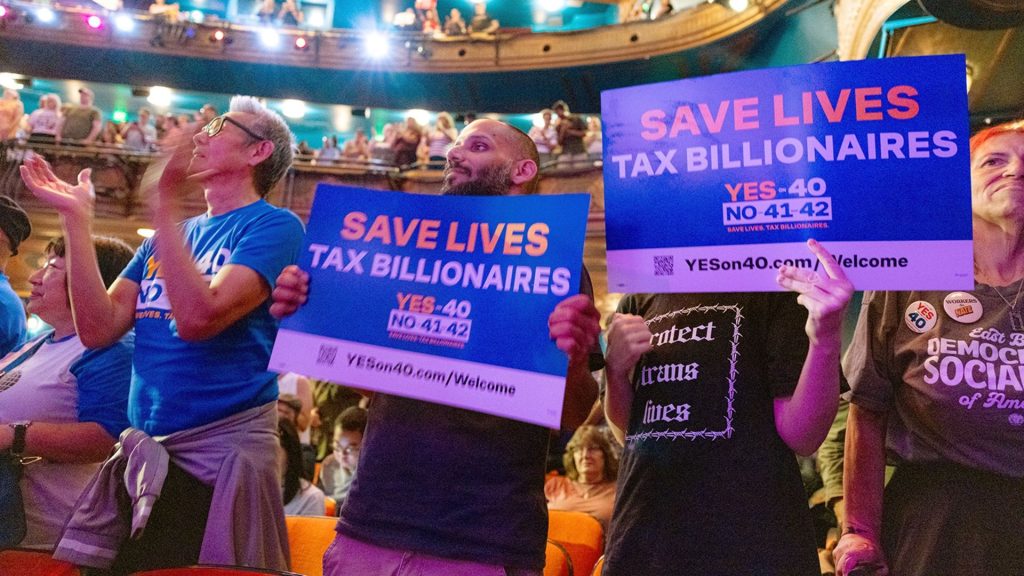
The defeat of a billionaire tax in California strikes “at the heart of the progressive agenda,” said Andrew Duehren in The New York Times. On the surface, the ballot initiative “seemed like a political layup”: a onetime 5% levy of the accumulated wealth of anyone living in California worth over $1 billion. It had powerful backers, including independent Vermont Sen. Bernie Sanders, Rep. Ro Khanna (D-Calif.), and numerous workers’ unions. And elsewhere in the country, “many Democratic candidates, like James Talarico in Texas, routinely attacked billionaires” and maligned inequality.
Such attacks and proposals leaned on the idea that billionaires should pay their fare share by taxing their vast investment holdings, not only their income, which is often relatively low. But even in liberal California, the “potent anti-tax sentiment in American politics” proved too much to contend with. Failure to pass the measure — which was opposed by 52% of voters — raises questions about whether progressives should try again to “tax the rich.
You can be sure that Democrats will be undeterred, said Matthew Hennessey in The Wall Street Journal. California officials have already floated putting another wealth tax on the ballot in 2028, acting as if they “don’t care what the people say when they go to the polls.” They fail to realize that a billionaire wealth tax would “create a giant sucking sound across the American South” as Silicon Valley billionaires pack their private jets faster than you can hum the chorus of “Choosin’ Texas.” And a national wealth tax — if such an unpopular idea gets floated again by a Democrat — would send the rich sprinting for shelter outside the country.
That’s what they have always done, said Adam Michel in The Washington Post. France, for instance, repealed its annual net wealth tax in 2017 after concluding “that it had driven 10,000 people with $39.3 billion worth of assets out of the country.” The exodus “shrank the overall tax base and caused the government to lose money.” And there are other ways to dodge high taxes that don’t involve a passport. Mark Zuckerberg coerced Meta’s board to issue him new stock he could sell to pay the proposed California tax without losing voting power or a dime of his fortune. Wealth can always be “revalued, reclassified, divided, moved, and hidden.”
“Imposing additional taxes on billionaires isn’t out of the realm of possibility,” said Erika D. Smith in Bloomberg. What was instructive about the California measure wasn’t the outcome but the messaging. Google co-founder Sergey Brin was the proposal’s leading opponent, and he moved to Nevada to demonstrate “the lengths to which he’d go to avoid having his wealth taxed.” But he also tried to stay “behind the scenes” and out of fray as much as possible. That suggests there’s still enough “backlash to billionaires” and oligarchs “to undergird another attempt.”
People have been debating the tax idea for years