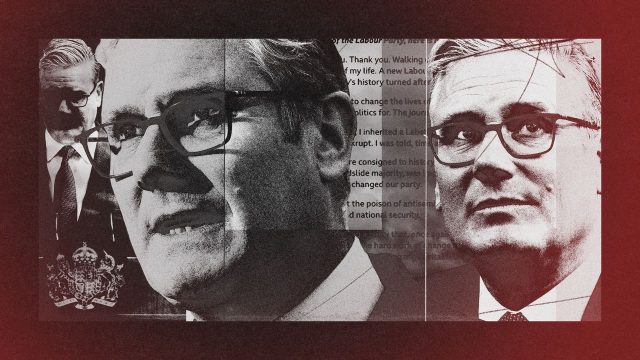
Keir Starmer announced his resignation this morning, saying he had heard the answer to the question as to whether he was the right person to lead Labour into the next election and would “accept that answer with good grace”.
The pathway from landslide electoral victory in 2024 to candidate for most unpopular prime minister of all time must be “one of the shortest honeymoon periods in British political history”, said Becky Morton and Brian Wheeler on the BBC.
What did the commentators say?
Shortly after becoming prime minister, Starmer boasted “that there would never be such a thing as Starmerism”, said Morton and Wheeler. But what he saw as a lack of ideological baggage ultimately translated – in the eyes of the public and many within his own party – to a perception that the prime minister “was, simply, not very good at politics”.
“There is something lame about him that Starmer has struggled from the start to shrug off,” said Ameer Kotecha in The Spectator. His lack of charisma was sold as a sign of the dutiful competence that was supposed to distinguish him from the perceived frivolity of the Liz Truss and Boris Johnson eras. But over the course of his premiership, the Starmer who has emerged “appears constantly at the mercy of events”, his occasional moments of “startling ruthlessness” somehow “even more unattractive than his mere ineptitude”.
Starmer “arrived for a career in politics unprepared for what a career in politics actually means”, said Andrew Marr in The New Statesman. The former director of public prosecutions went from courtroom to “cage fight”, and never managed to sell himself or his messaging “in a raucous, jeering environment where many assumed he was a compulsive liar”. In taking on the premiership of a fractured, stagnating Britain, he “chose a painful, treacherous path at an unusually difficult time”. If it “hasn’t worked”, it is “by no means all his fault”.
What next?
“The beneficiary of Starmer’s demise is all but certain to be Andy Burnham,” said Sonia Sodha in The Times. Burnham is “a warm and effective communicator” – but he must use that charisma to “strike a realistically ambitious tone” and sell the public on “hard truths” about the road ahead, rather than quick-fix solutions whose inevitable failure will only benefit populist parties.
A Burnham administration “will test the power of personality over policy”, said The New York Times. His allies pin their hopes on his talents as “an effective storyteller who can counter the inflammatory rhetoric of populist rivals” in a way that always eluded Starmer. But so far his vision for the nation has been confined to “sweeping generalities” that offer little insight into how he will address huge challenges like “economic stagnation”, public sector funding and “ascendant, anti-immigrant populism”.
Tim Bale, a professor of politics at Queen Mary University of London, said the picture for Labour has become so “bleak” that most party insiders will be happy if Burnham can simply “persuade people to give the party a second look”. But “if the sausage isn’t going to change, when it comes down to it, all he’s really offering is some sizzle”.
Outgoing PM never recovered from rocky first impression, but likely successor Andy Burnham will need more than charisma to stave off populist challengers