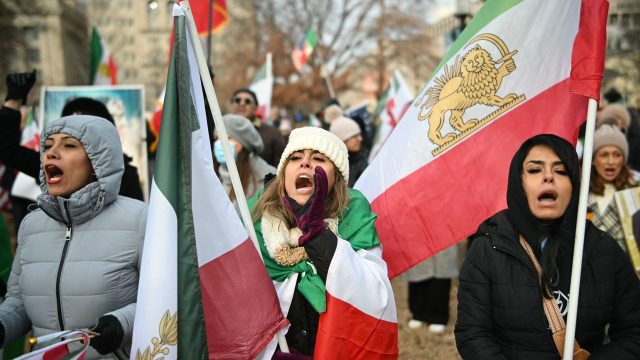
It’s astonishing how quickly the flames of protest have spread across Iran, said Ara. On Sunday 28 December, a couple of small protests in central Tehran, one outside the Alaeddin mobile phone centre and another by the Sabzeh Meidan currency exchange, led shopkeepers in the grand bazaar to close their doors in solidarity, and in a matter of days the unrest had spread like wildfire across the country.
The Islamic Revolutionary Guard Corps (IRGC), the powerful military force that underpins the regime and controls somewhere between 20% to 40% of Iran’s economy, has reacted with severity, using bullets, water cannon and tear gas against the demonstrators; at least 35 people have been killed and some 1,200 protesters arrested.
Expression of the ‘political fracture’
The spark for all this was yet another sharp fall in the exchange rate, said Middle East Eye. The depreciation of the rial, the Iranian currency, has been a constant feature of life under Ayatollah Ali Khamenei, but since Israel’s strikes against Iran’s nuclear facilities in June, the rial’s fall has accelerated mightily: it has lost 40% of its value, making it hard for Iranians to import many essential goods. And adding to the hardship has been a hike in petrol prices: Iran has some of the cheapest petrol in the world, but mounting economic pressure has obliged the regime to cut back on the massive subsidy for it.
Such setbacks are just the latest reflection of deeper economic woes, brought about partly by international sanctions, but also by the grotesque economic mismanagement and corruption of Khamenei’s theocratic regime, said Sanam Vakil in The Sunday Times. People’s “household savings have been wiped out; real wages have collapsed; large segments of the middle class have been pushed into precarity”. That is why the present unrest shouldn’t be seen as a “simple reaction to the economic crisis”, said Pegah Moshir Pour in La Repubblica . What we are seeing is an expression of the “political fracture” that for decades has run through Iranian society, but only burst into the open in September 2022, when mass protests broke out over the death in custody of 22-year-old Mahsa Amini, who had been arrested by the morality police for not wearing her hijab properly.
Indeed, many Iranians are now expressing their frustration at the “entire system”, said Maryam Sinaiee in Iran International. They’ve no faith in the president, Masoud Pezeshkian, and his promises of economic reform. They know he is merely a figurehead, that the real power lies with the 86-year-old Supreme Leader Khamenei, who has been in power since 1989, controls the IRGC and holds billions of dollars worth of Iranian properties and companies. This is why so many of the protesters’ slogans – some have openly chanted “Death to the dictator” – are targeted not at the exchange rate but “at the theocratic system itself, and its supreme leader”.
‘Disorganised and leaderless’
After Israel’s military strikes in June, analysts thought Iranians might “rally behind their regime”, said The Wall Street Journal. They couldn’t have been more wrong. And what makes these protests “all the more remarkable” – protests that have been concentrated not in Tehran but, most unusually, in the smaller cities outside it – is the fact that the authorities have ramped up their repression since the summer. They’ve rounded up 21,000 “suspects” and increased the number of executions: somewhere between 1,500 and 2,000 are believed to have taken place.
But let’s not get carried away, said The Economist. The protesting crowds are not nearly as large as those of three years ago; the protest movement itself is “disorganised and leaderless” and the opposition is “adrift”. So the most likely outcome of all this is that the demonstrations “will fizzle out or be crushed, much like past rounds”. But, then again, Donald Trump has told Tehran that it will get “hit hard” if it kills any more protesters, and that the US is “locked and loaded and ready to go”. And given what has happened in Venezuela, you can never be sure.
Deep-rooted discontent at the country’s ‘entire regime’ and economic concerns have sparked widespread protest far beyond Tehran