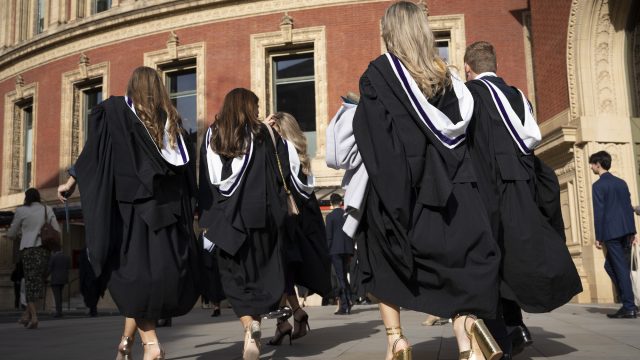
The Conservatives have pledged to scrap “rip-off” degrees at universities if they win the general election. The party said it would introduce a new law that would allow the independent regulator, the Office for Students, to cancel the “worst-performing” courses and redirect funds into expanding apprenticeships.
Up to “one in eight students could see their course axed” in a bid to weed out “Mickey Mouse” courses that sell students a “false dream”, said the Daily Mail. Courses will be judged on criteria which include drop-out rates, job progression and earning potential, the Tories said.
However, opposition parties derided the announcement, with Labour calling it “laughable” referring to the Tory government having “presided over” a halving of apprenticeship numbers while in office.
More pertinently, the announcement comes at a time when universities are facing a funding crisis. A combination of high inflation, frozen fees and falling student numbers has left many universities set to operate at a loss, and “few expect that the government would step in to bail out a university in serious financial difficulty”, said Hannah Rose Woods in The New Statesman.
What is happening at universities?
An increasing number of universities are laying off staff because of funding shortfalls with “over a quarter of the sector” confirming redundancy programmes, said Woods, while “restructuring programmes” could see a “quarter of all academic roles” cut from some universities.
Other universities are “freezing budgets and merging departments”, meaning even those staff who are escaping the threat of redundancy are being hit with “paused pay and promotions”, said the Secret Lecturer at the Higher Education Policy Institute.
There is also a sense that “education seems to be ever lower on the list of priorities” for those who own universities, which are acting “almost like hedge funds” and “investing in lavish new properties” but cutting spending on courses and staff.
What are the causes?
UK universities “expanded rapidly over the past decade” but are now finding themselves in a sticky situation as numerous constricting factors collide, said the Financial Times (FT).
The first is the drop in overseas student numbers. Universities pursued “unsustainable expansion” by “exploiting” the demand of students from China and elsewhere who wanted to study in the UK and would pay high fees to do so, a Tory minister told the FT. But now a combination of changes, including Brexit and migration policies that make it more difficult and expensive for overseas students to get visas, are leaving universities with a black hole in their finances.
To exacerbate that, tuition fees for domestic students have been frozen for a decade and will continue to be for at least two more years. While that is good news for students who will not be saddled with any more debt than before, the “rising operating costs” and the “drop-off in higher-paying international students” means these fees no longer cover many costs of the courses for universities.
Yet students are also facing significant difficulties that are stopping many people from attending university altogether. The “spiralling” costs of housing, transport and food is leaving many students unable to survive financially, said Woods, and research suggests “one in 10 students are accessing food banks”.
The declining quality of courses on top of the financial difficulties means many students’ attendance rates have “fallen off a cliff”, said Jedidajah Otte at The Guardian, while many are being forced to “prioritise paid work over studying”.
What can be done?
The outlook for many universities currently looks bleak and “government help for universities seems unlikely”, said Stephen Armstrong at Tortoise. The current government had hoped that universities would “find productivity gains to cover rising costs”, however, vice-chancellors are seeing “job cuts as the main way to save money”, in turn affecting what can be offered to students.
While there is some level of self-infliction, governments have failed to understand the “unintended – though widely predicted – consequences of their legislation” with few people seemingly having an “adequate grasp of the structure of higher education or the way it is financed”, said Woods.
There is hope that a potential Labour government will “at least” make changes to “encourage lucrative foreign students and welcome them in”, said Polly Toynbee in The Guardian. However, there is still a sense that everyone involved remains “unprepared for what is coming”, concluded Woods, and we are no “closer to an alternative vision for how to keep those world-leading universities in business”.
A combination of spiralling costs and fewer international students is leaving universities in serious financial trouble