
The UAE has denied Benjamin Netanyahu’s claim that he made a secret trip to the Gulf state during the Iran war to meet the president, Sheikh Mohamed bin Zayed Al Nahyan.
With The Wall Street Journal reporting that the UAE has carried out its own strikes on Iran, there is a renewed focus on the Abraham Accords – the peace and cooperation agreements between Israel and several of its Arab neighbours.
What are the Accords?
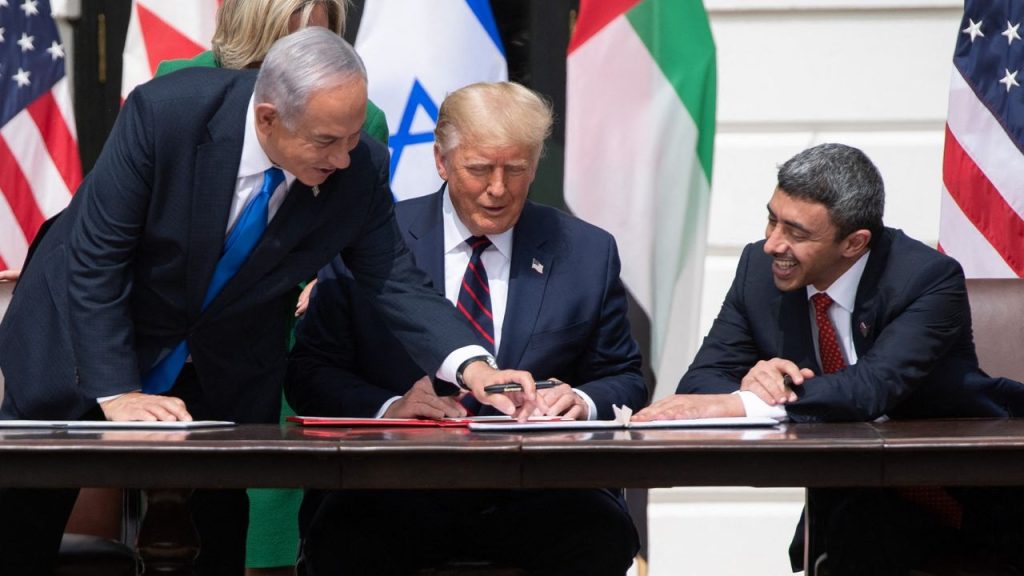
The Abraham Accords are a series of agreements between Israel, UAE and Bahrain, normalising Israel’s relations with several Arab nations. The initial accords, which were mediated by the US, were signed on 15 September 2020. Three months later, Sudan and Morocco joined the pact.
States such as the UAE and Bahrain saw the Accords as strategically useful but large parts of Arab public opinion remain strongly pro-Palestinian and opposed to closer relations with Israel. The Gaza war widened this divide and then the Iran war created a sense that the region was being dragged into instability through Israeli-Iranian confrontation.
So Arab governments face a growing dilemma because maintaining ties with Israel and the US risks a domestic backlash but breaking ties could damage security and economic interests.
Tehran’s “narrative” became that it could target “at will” the countries that had signed the Abraham Accords with Israel, said The Jerusalem Post. This reinforced fears in Saudi Arabia in particular that overt alignment with Israel could make the kingdom a direct target.
How might they be updated?
The original vision of the Accords – of a rapidly expanding regional bloc openly aligned with Israel and integrated economically across the Middle East – has become a significantly weaker prospect. So future agreements could involve cooler normalisation, selective security cooperation, quieter diplomacy and a slower expansion.
The power of China has also encouraged the players to think about an update. Beijing has “spent the better part of two decades cultivating Middle Eastern influence”, with infrastructure finance, arms sales and “diplomatic mediation”, said US conservative think tank the Hudson Institute. But an “expanded and strengthened” Accords would create a “competing network rooted in shared security interests and American sponsorship”.
What would it look like?
The Accords have “demonstrated resilience” despite the “turbulence” of the past two and a half years, including “growing criticism of Israel in parts of the Arab world”, said Roy Binyamini, a former National Security Council official, on Ynet.
But the US and its Accords partners could outline a “vision for regional stability, economic growth, interfaith tolerance and the containment of extremist influences”.
Meanwhile, Israel could “leverage its experience” to help regional partners in “strengthening civilian defence systems, including air defence capabilities and protection of critical infrastructure”.
Israel’s agreements with some Arab neighbours are being reconsidered in the light of the Iran war