
The Turner Prize no longer inspires the excitement and the “ire” that it used to, said Waldemar Januszczak in The Times. Once the “main event” of Tate Britain’s schedule, it is now a travelling show, chugging around provincial museums. In principle, this is an admirable attempt to “spread the word about contemporary art”, but in practice it means the Turner has become rather a sideshow.
This year’s iteration takes place in Middlesbrough, a corner of the country that has recently been much maligned. As ever, it presents the work of four British artists (or artists working in Britain) who are nominated for exceptional exhibitions in the past year.
The winner receives £25,000, the runners-up £5,000 each. And in this case, the participants truly deserve it. All of the nominees field “solid showings” – and, for the first time in years, “there is a genuine sense of the display putting its finger on Britain’s artistic pulse… I loved it.”
‘Boring’ at points
This year’s show, which features no painters, is “relatively conventional – and even, at points, boring”, said Alastair Sooke in The Telegraph. Kira Freije (b.1985) fashions figurative sculptures from “aluminium casts of parts of her own body and others’ faces”, creating “skeletal” effigies draped in “faded scraps of folksy fabric”. She fills a room with them, her creations projecting “a dramatic, sorrowful quality” that evokes “a broken world populated by impoverished survivors”. It’s impressive enough, but it feels “rehashed”: Freije fails to “synthesise” her influences.
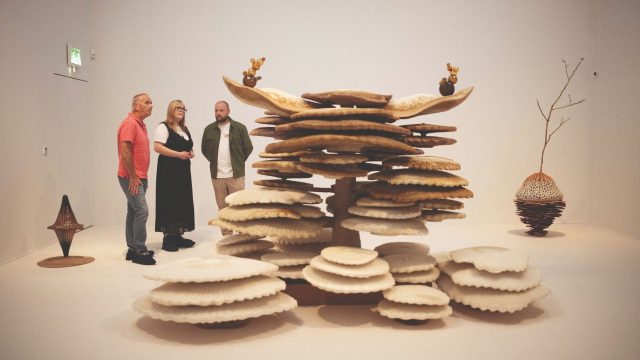
Far better is the French artist Marguerite Humeau (b.1986), whose huge sculptures of animals, including a dying elephant and dramatically enlarged fungi, have “genuine flair, originality and refinement”. Humeau’s description of her own art – she says she is on a “quest” for “transcendence” – can sound a bit “hippy-dippy”, but the “unsettling” proliferation of sculptural forms she creates is “bizarrely beautiful”.
‘Feels, smells and tastes’ like modern Britain
Far from being disappointing, “this is one of the strongest Turner Prize shows in recent memory”, said Mark Hudson in The Independent. The favourite to win is 31-year-old Tanoa Sasraku. One piece covers an entire wall with paper imitations of fabric patterns used by her father, a Ghanaian fashion designer, coloured with saturated earth dyes. It has the air of “something Mark Rothko might have produced”, if he’d worked with wrapping paper.
My personal favourite, though, is Simeon Barclay (b.1975), who presents a spoken-word piece synced to a video, itself presented within a replica of the Huddersfield nightclub he was barred from as a teenager. It’s about growing up Black in South Yorkshire, and it hymns the M62 – the motorway “that connected Huddersfield, and by extension Barclay, to the wider world”. Maybe it’s odd to have spoken-work poetry in an art prize, but it’s a piece that really “feels, smells and tastes” like modern Britain.
Middlesbrough Institute of Modern Art. Until 29 March.
The exhibition now in Middlesbrough has some ‘solid showings’ – but is the art too conventional?