
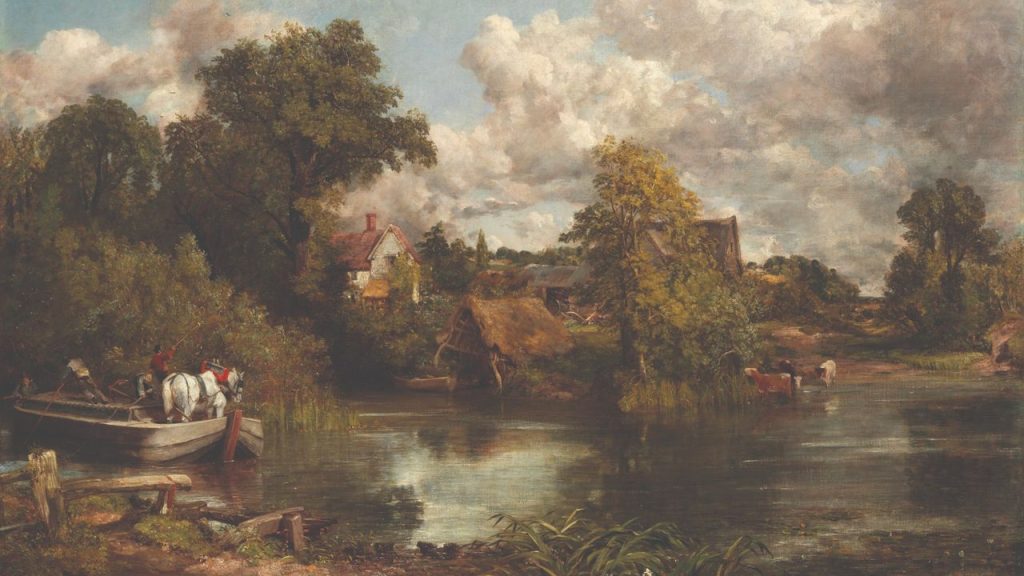
Although they were born within little more than a year of each other, it’s difficult to think of two artists more “profoundly and incontrovertibly” different than J.M.W. Turner and John Constable, said Alastair Sooke in The Telegraph. The former was “a barber’s son who never lost his Cockney twang”; the latter came from a “genteel” Suffolk mill-owning family. Turner specialised in epic seascapes and Alpine vistas, always aspiring towards the sublime; Constable favoured the “down-to-earth”, painting rural scenes “invigorated with a novel dose of realism”.
Yet for all that separates them, they’re both renowned as our “greatest landscape painters” – and for good reason. Marking the 150th anniversary of their births, this “thrilling” show at Tate Britain brings together around 170 works by both, many of which haven’t been glimpsed on these shores for decades. The result could so easily have been “dutiful and boring”; instead, it’s a truly “absorbing” experience.
It’s an “epic confrontation”, agreed Mark Hudson in The Independent. Turner and Constable’s works are juxtaposed in a way that demands direct comparison – as often happened in their lifetime. Initially at least, Turner has the edge: his “Crossing the Brook” (1815) is a “magnificently atmospheric view” of the Tamar Valley that makes the latter’s “doggedly local” “Dedham Vale” (1828) look rather parochial. Turner’s dramatic seascapes – “Buttermere Lake” (c.1798), “Morning amongst the Coniston Fells” (c.1798) and “Fishermen at Sea” (1796) – place him in the same league as any of the European romantic artists. The locations are British, yet they still encapsulate all that is “awesome and terrifying in nature”. These would suggest that Turner’s was the “larger vision”.
Other juxtapositions, though, lead you to the opposite conclusion. “Salisbury Cathedral from the Meadows”, “a great visionary evocation of England”, makes Turner’s “Caligula’s Palace and Bridge” – also from 1831 – look like a mere exercise in “special effects”. Either way, “you’ll want to make your own mind up. Because you absolutely must see this exhibition.”
Turner’s fixation on the “sublime” can look like a “predilection for drama and vaporous emptiness”, said Adrian Searle in The Guardian. Constable, meanwhile, “is always specific, grounded, even when he is just staring at the clouds or into the impenetrable dark on a heath, the Moon half seen emerging from behind a bush, in its pale bloom of scattered light”. His paintings are “filled with stuff” – locks, churches, carts, windmills – celebrating the everyday reality of a “now vanished world”. You can “almost smell the river” in his 1826 painting of a man opening a canal lock. His “small and almost casual” studies of clouds moved me more than anything else here. Both artists were brilliant – but I know who “touches me more”.
Tate Britain, London SW1. Until 12 April
Celebration of two of the UK’s ‘greatest landscape painters’ at Tate Britain is a truly ‘absorbing’ experience