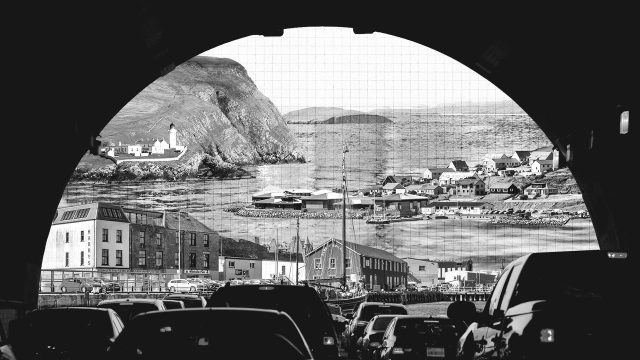
The Shetland Islands are famed for their remote beauty but for locals this comes at a cost. Now campaigners are pushing for the island’s ageing ferries to be replaced with undersea tunnels.
“The ferry service has served our islands very well but that’s a 20th-century form of transport,” Alice Mathewson, from North Yell Development Council, told The Guardian. “In the 21st century the answer is: dig a hole. Scotland has to drag itself into the 21st century.”
Short journey can take hours
Shetland is connected by a fleet of 12 ferries that make around 70,000 sailings a year to nine islands carrying about 750,000 passengers. The council says many of these vessels are operating beyond their intended working life and that ferries are a significant contributor to local carbon emissions.
A journey of a few miles can take hours, provided the ferries run at all given bad weather, common in the North Atlantic, mean sailings are often cancelled.
“For time-pressed islanders, care workers and businesses, it adds delays, stress and costs,” said The Guardian. The social consequences of relying on ferries are also “significant”, because they drive “depopulation and isolation”.
Cut journey times by up to 80%
The answer to Shetland’s problems may lie 230 miles to the northwest. Between 2002 and 2022, a £360 million project connected the Faroe Islands through a series of undersea tunnels. Boasting what is thought to be the world’s first submarine roundabout, the road network has cut journey times by up to 80%, been credited with helping to revitalise the territory’s economy and contributed to net immigration over the past decade. Funded largely by borrowing, the costs are being recouped by tolls that start at £2 for residents.
With Shetland’s “unreliable” ferry service “holding the Scottish islands back”, it is hardly surprising its residents “are contemplating building a tunnel system of their own”, said The Times. Earlier this month a delegation of Scottish MPs visited the Faroe Islands to see if such a scheme could be replicated on Shetland.
‘Steeped in Scandinavian engineering’
A campaign by residents on Yell and Unst, the most northerly of Shetland’s islands and backed by the local Lib Dem MP, Alistair Carmichael, is “credited with forcing tunnels and bridges firmly on to the political agenda”, said The Guardian.
Last year, the group commissioned and funded geological surveys and engaged advisers “steeped in Scandinavian tunnel engineering” to try to “prove their economic, social and financial value”.
A report on Shetland Islands Council’s inter-island connectivity programme published last summer proposed four undersea tunnels be taken forward for consideration. There are “no cost estimates at this stage”, said Shetland News, though it would be expected to run into the hundreds of millions.
“Three major European tunnelling contractors” were appointed in December “to undertake the next phase of work on proposals to replace some Shetland ferry routes with fixed links”, said New Civil Engineering. They will “assess” the “test case” that is under way at the Yell Sound crossing, one of the busiest inter‑island routes. Councillors are expected to consider the next stage in summer 2026, when preferred options for each of eight island routes in the programme will be selected.
“I have always said the most difficult tunnel to be built would be the first one,” said Carmichael. “Once you’ve proven the concept, you won’t have to make the case [for others]. Communities will be banging on your door.”
Replacing ferries with undersea road network could revitalise the local economy and reverse depopulation, say campaigners