I never thought I’d feel nostalgia for the Iraq War, said Nesrine Malik in The Guardian. But it turns out that the runup to that conflict, when America did at least strive to convince the world of the righteousness of its cause, was the “good old days”.
There was no such effort to legitimise the US strike on Venezuela and the abduction of its president, Nicolás Maduro. Nobody sought consent from any international body or Congress. And while a flimsy legal case was made for the coup – a court charged Maduro this week with, inter alia, “narco-terrorism conspiracy” and possession of machine guns – the Trump administration’s predatory objectives were transparent.
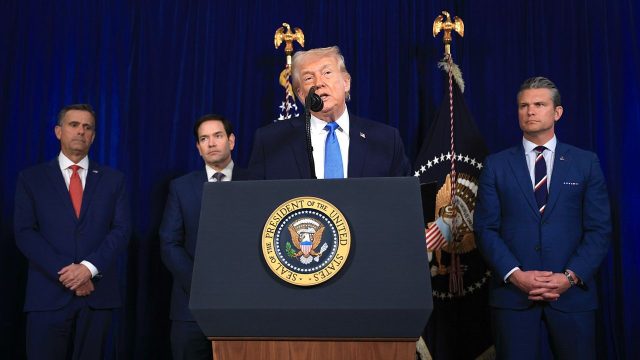
The US will “run” Venezuela, said Trump; US oil companies will “go in” and take “a tremendous amount of wealth out of the ground”.
‘Gunboat diplomacy’
There’s no disguising the truth about this operation, said Thomas Fazi in The Daily Telegraph: it was a “completely unprovoked and blatantly illegal act of aggression against a country that posed no real threat to the United States”. And Trump is threatening to carry out more such acts of “military adventurism”, said Edward Luce in the FT. He has advertised designs on Panama, Canada and Greenland. On Saturday, he claimed that “something is going to have to be done with Mexico”, lamenting the power of its drug cartels, and warned Gustavo Petro, Colombia’s left-wing president, to “watch his ass”. The US secretary of state, Marco Rubio, said the “incompetent and senile men” running Cuba should be “a little worried”.
Trump has talked of reasserting the 19th century Monroe Doctrine (which he has facetiously recast as “the Donroe doctrine”) to restore US pre-eminence in the Western Hemisphere, said Patrick Cockburn in The i Paper. It seems America is returning to the days of “gunboat diplomacy”.
The truth is that it never really left them, said Trevor Phillips in The Times. From Ronald Reagan’s invasion of Grenada to George Bush Sr’s seizure of the Panamanian dictator Manuel Noriega, there’s nothing new about Washington wielding force in Latin America. “The first rule of the rules-based order is that America makes the rules, and it makes them to suit America.”
The only difference is that Trump is open about it. Power, not “international law”, is the ultimate guarantor of security, said The Wall Street Journal. Last weekend’s display of “US nerve and military prowess will do more than a thousand UN resolutions to protect the free world and make Russia, China and Iran think twice”.
The Caracas raid was primarily about China, said Doug Stokes in The Spectator. Beijing has been quietly increasing its presence in Latin America and the Caribbean: in 2024, its trade with the region hit a “staggering” $515bn. Maduro’s capture was less about securing oil than about stopping Beijing from “establishing a forward operating base in the Americas”.
US is a ‘regional bully’
“No autocrat likes to see one of their own seized, shackled and renditioned,” said Adrian Blomfield in The Daily Telegraph. But China and Russia won’t be that upset about the ousting of their ally Maduro. The lesson they’ll draw from this episode is that the US is withdrawing from a global role in pursuit of regional hegemony. A world carved up into “spheres of influence” – within which powerful states and strongman rulers can do what they like – would suit Moscow and Beijing just fine, agreed Gideon Rachman in the FT.
Indeed, back in 2019, Trump’s former Russia adviser Fiona Hill told Congress that the Russians had been, in her words, “signalling very strongly that they wanted to somehow make some very strange swap agreement between Venezuela and Ukraine”. America’s rivals will also be delighted by Trump’s flouting of international law, said Stephen Glover in the Daily Mail. The US may not always have lived up to its high ideals, but by disregarding them entirely, Trump has “recklessly sacrificed America’s moral leadership”.
And all for what, asked Mary Dejevsky in The Independent. If Venezuela is successfully restored to a functioning democracy, Trump will be able to claim victory. But if, as is all too likely, the situation descends into chaos, he’ll be “very vulnerable”. After all, he promised to extract the US from intractable conflicts, not start new ones. Venezuelans won’t want to “live in a Trump-backed dictatorship staffed with Maduro cronies”, said Anne Applebaum in The Atlantic. Nor will most Americans want to see their military being used to fight on behalf of oil interests. If the US becomes just a “regional bully”, it will alienate friends and foes alike, eventually leaving it “with no sphere, and no influence, at all”.
Following the capture of Nicolás Maduro, the US president has shown that arguably power, not ‘international law’, is the ultimate guarantor of security