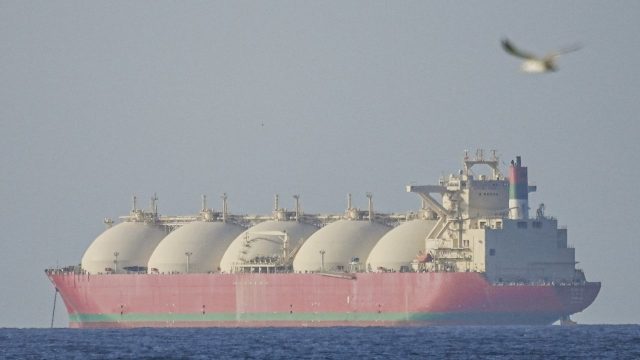
The price of crude oil could rise to $150 a barrel under a US blockade of the Strait of Hormuz.
Jorge Montepeque, managing director of oil traders Onyx Capital Group, said prices “should be $140, $150” if the naval blockade goes ahead, said The Telegraph.
The US blockade was due to begin at 3pm today UK time. Writing on social media, Donald Trump said that the US was going to start “BLOCKADING any and all Ships trying to enter, or leave, the Strait of Hormuz” and will “interdict every vessel in International Waters that has paid a toll to Iran”.
How will it work?
Under Trump’s plan, instead of having navy ships escort commercial vessels through the Strait of Hormuz, US forces will board and potentially seize any vessels that pay Iran’s toll, a move that would effectively close the strait off entirely.
The US Central Command said that its forces would not impede the freedom of vessels travelling to and from non-Iranian ports. It also pledged that it would release additional information to commercial mariners.
The president warned that “any Iranian who fires at us, or at peaceful vessels, will be BLOWN TO HELL”, but “at some point” an agreement on free passage would be reached. He said that other countries would be involved in blockading the strait, but did not specify which. Keir Starmer said the UK would not join the blockade.
What will the effect be?
The consequences for the global economy could be serious. There’s “little clarity” about how the US navy will take control of the strait without “reigniting” the conflict with Iran and “causing another shockwave” in the money markets, said Michael Evans in The Times.
The blockade “might risk worsening a war-driven global energy crisis”, said The Washington Post. Although Iran would “potentially suffer the most economically”, it may also “come as a blow to the rest of the world”, particularly nations in Asia, which “rely heavily” on oil and gas from the Gulf.
So the president is “once again playing loose with the fortunes of financial markets and the global economy as he struggles to find a way out of the war”, said Australia’s ABC News.
As for Trump, the plan “reflects his hope” that he can repeat the “model of his intervention” in Venezuela, said the Financial Times. There, the US “seized” the then president Nicolás Maduro in a military operation after a naval blockade of the Latin American nation.
“You saw what we did with Venezuela,” Trump told Fox News. “It’ll be something very similar to that, but at a higher level.”
What did experts say?
Initially, Trump’s plan will only affect the small number of vessels that are still navigating the waterway, shipping expert Lars Jensen told the BBC. If the US does blockade the strait, it will “halt a very tiny trickle” of vessels and “in the greater scheme of things, it doesn’t really change anything”.
But three legal experts in the US said the blockade could violate maritime law. One of them suggested the blockade, which will be enforced militarily, would violate the current ceasefire agreement.
The blockade is a good “counterpoint” to Iran’s closure of the strait, Dennis Ross, the former senior US diplomat and Middle East negotiator, said on X. It puts “greater pressure on Iran” and “great pressure on China to pressure Iran”.
But Vali Nasr, a former US official and a professor at Johns Hopkins University, told the Financial Times that the plan will be “fine by the Iranians” because it “prolongs the chokehold on the global economy”.
Tehran might respond by shutting down the Bab el-Mandeb, a chokepoint off the coast of Yemen, said Nasr, and “then the US will have to deal with that”.
The US will blockade Iranian ports after talks between the two sides failed