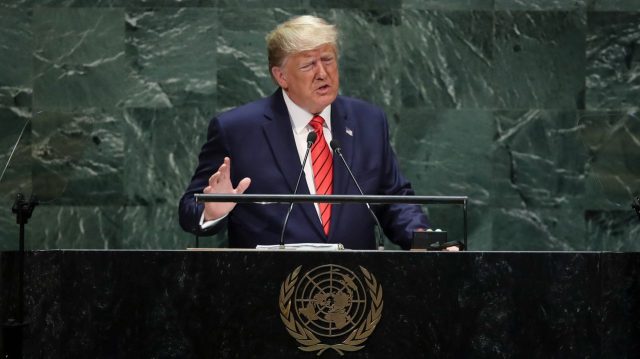
After months (if not years) of saber-rattling, President Donald Trump this past weekend made good on his longstanding threat to take military action against Iran, authorizing U.S. armed forces to partner with the Israeli military in a massive show of force against multiple Iranian targets. In this, his biggest military action to date, the man who ran for office on a platform of “no new wars” has shown the world an emerging new doctrine for the use of American military force. While there’s little question that Trump’s attack on Iran is intended in no small part as a message for the rest of the world, the specifics and logic of that message remain very much in question.
‘Coherent and prudent’ strategy
In many ways, Trump’s is the “anti–Powell Doctrine,” said Foreign Affairs, citing the policies established by then-General and eventual Secretary of State Colin Powell during the first Iraq war. While that philosophy held that war should only be undertaken as a last resort after exhauting other options and “in pursuit of a clear objective, with a clear exit strategy, and with public support,” Trump’s doctrine holds that military action is merely “one of several tools available” to be used to “increase leverage, maximize surprise, and produce outcomes.” The U.S under Trump appears “increasingly intent” on relying on “discrete yet disruptive military action” over “prolonged interventions,” said Responsible Statecraft. The administration operates to “secure advantage without costly military entanglements or the fatigue of colonial or quasi-imperial overreach,” even as it challenges the “post–World War II international institutional architecture.”
This new doctrine’s use of “tailored, overwhelming force to maximize deterrence and achieve long-term strategic benefits” marks a “coherent and prudent” strategy on the part of the president, said The Wall Street Journal. By “systematically pressuring exposed adversaries,” such as Venezuela or Iran, the “influence of strategic rivals is undercut.” And if the “military components” are “one part of its effectiveness,” it’s Trump himself who is “another” for having “proved to be the only U.S. president willing to wage a true war of attrition against Tehran.”
Trump’s ordering of military operations in Africa, Central America, and the Middle East has been seen as an “escalating cycle of force,” stoking fears which are “understandable given the administration’s inflammatory rhetoric,” said The National Post. The “common thread,” however, is “not escalation, but political opportunism,” wherein force is applied solely when “political and military costs appear low” and in “pursuit of quick wins that serve a limited foreign policy agenda.” As the administration frames every military action for “maximum political effect,” this pattern “becomes clear” when combined with Trump’s “over-the-top rhetoric” and bluster: His is a doctrine designed to “project strength” while avoiding the “political costs of sustained engagement.”
National interests made ‘personal’
The new Trump doctrine is about “removing foreign leaders who threaten the U.S., without being drawn into a military quagmire,” explained Sen. Lindsey Graham (R-S.C.) to “Meet The Press,” per MS Now. But critics contend that Trump is “creating the worst of both approaches to intervention” by “using U.S. military force aggressively and recklessly” while simultaneously counting on his adversaries to “capitulate” as they have “in business and politics.”
Broadly, Trump’s moves against Venezuela, and now in the Middle East, are designed to “cement America’s status as the number one energy superpower,” as he said at a recent rally. In the wake of his attack on Venezuela earlier this year, Trump’s moves were seen as more than just a “return to such de facto imperialism,” as outdated notions of “great spaces” of influence, said The Guardian. Instead, Trump’s pledge to “run” Venezuela on behalf of oil companies signals the “internationalization of one aspect of his regime — what has rightly been called the logic of the mafia state.” Here, corruption is not conducted clandestinely, but rather “public procurement is rigged,” with large companies “brought under the control of regime-friendly oligarchs,” who in turn “acquire media to provide favorable coverage to the ruler.”
Under this iteration of Trump’s rule, America is “not a state looking after itself” but rather “leadership, and in particular one leader” tapping national resources to “serve his very individual and selfish interests,” said University of St. Andrews International Studies Professor Phillips O’Brien on Substack. This dynamic “destroys much international relations theory,” which assumes that “regime type/leadership matters very little” since they are all merely looking to “get as big and strong as they can in a chaotic world.” In other words, America’s war on Iran is a “war of choice, chosen by Donald Trump to meet some very personal needs.”
A hastily launched war of vaguely articulated goalposts in Iran has thrust Trump’s vision of expanded empire into a spotlight for which it might not be ready