
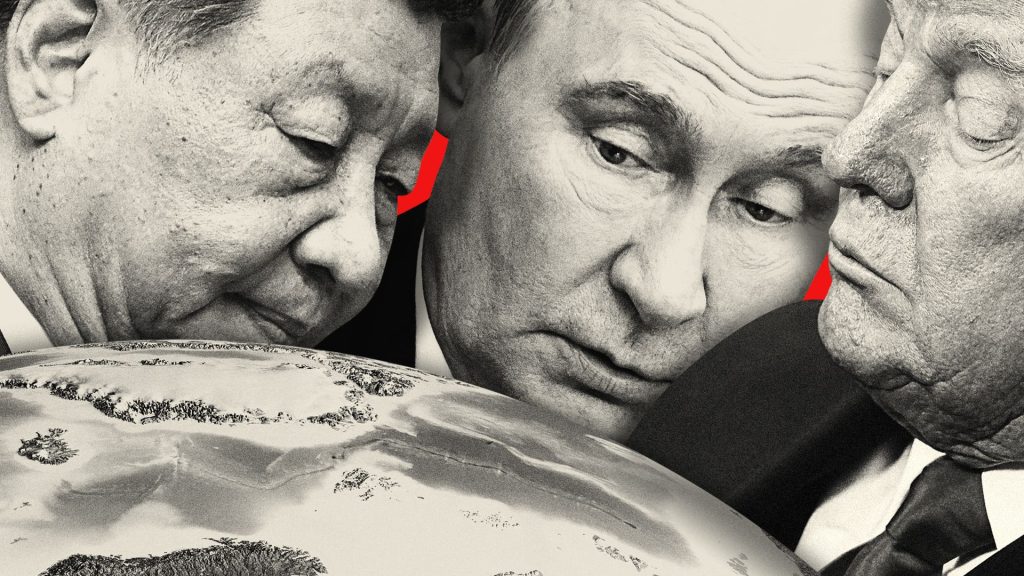
Donald Trump, Xi Jinping and Vladimir Putin will gather face to face for their first trilateral meeting in Shenzhen, China, later this week.
The prospects of a backroom deal emerging from this encounter on the sidelines of the Asia-Pacific Economic Cooperation summit are “slim”, said Reuters. But even the remote possibility of the “big three” cutting a “private deal” will cause “deep unease” for other geopolitical players.
What did the commentators say?
Some are calling this meeting “Yalta 2.0”, said the Financial Times, referring to the momentous 1945 meeting between Franklin D. Roosevelt, Winston Churchill and Joseph Stalin that “decided the post-Second World War international order”. That comparison will probably prove overblown but “the powerful imagery of Trump meeting authoritarian Xi and revanchist Putin will reverberate throughout the world”.
For Russia, the meeting represents a “spectacular reversal of fortune”, said foreign-policy specialists David Blair and Roland Oliphant in The Telegraph. For Kremlin propagandists, “it’s proof” not only that Russia has “escaped isolation” on the world stage but also that it’s “secured a place at the pinnacle of global power”. Unlike Washington and Beijing, Moscow will be looking beyond the optics for “real outcomes” – particularly on Ukraine.
Trump will be “eager to flex power” at the summit, said Bloomberg. Facing “lame-duck status” at home after the midterm elections, he will be keen to bolster his international standing by seeking support for trade agreements, the war in Iran, and denuclearisation. But any deepening of ties with Xi and Putin will “set off alarm bells in Kyiv” and other Western capitals over what that means for US involvement in Ukraine.
Despite being the only country of the three not facing the pressure of war, China may be “uneasy” about hosting this trilateral on its home turf, said the Lowy Institute international-policy think tank. The talks could easily “backfire”, tarnishing China’s efforts to be perceived as a force of “peace and stability”. Xi will navigate those “risky waters” by avoiding formal agreements or “concrete” solutions and focusing instead on “reiterating the positions of the three countries” over “the problems they face”.
What next?
The Shenzhen meeting should “not be interpreted as evidence that the three countries are approaching a common strategic position”, said Modern Diplomacy. They still have “substantial” disagreements and “competing interests”. But it is “an unusual diplomatic opportunity”: it could open up direct communication channels that could “help manage differences and reduce tensions”.
For other world leaders, the significance of this summit will depend on whether or not it “moves beyond diplomatic statements”.
Strongman rivals to hold trilateral that may chill other global powers