Should technology that’s going to determine America’s future be left “in the hands of 50 state legislatures?” asked Michael Solon in the New York Post. President Trump doesn’t think so. Last week, he signed an executive order setting up an “AI Litigation Task Force” to challenge state laws on artificial intelligence that the administration considers overly burdensome. The order also threatens to restrict those states’ access to federal broadband funding. In an online post, Trump explained correctly that America’s global leadership in AI “won’t last long” if every state imposes its own regulations, forcing AI companies “to get 50 Approvals every time they want to do something.” Consider California’s innovation-crippling “woke” regulations, which require all AI models to comply with Sacramento’s requirements for “safe, ethical, equitable, and sustainable” systems—or else face a $1 million fine. But make no mistake: Trump’s order is a “jerry-rigged solution at best.” The Constitution charges Congress, not the president, with regulating industries involved in “interstate commerce,” and Trump’s order could be nixed by legal challenges. Still, in this age of congressional dysfunction, and given the stakes of our AI race with China— where there are no restrictions at all impeding development—can we really blame the president for “taking action?”
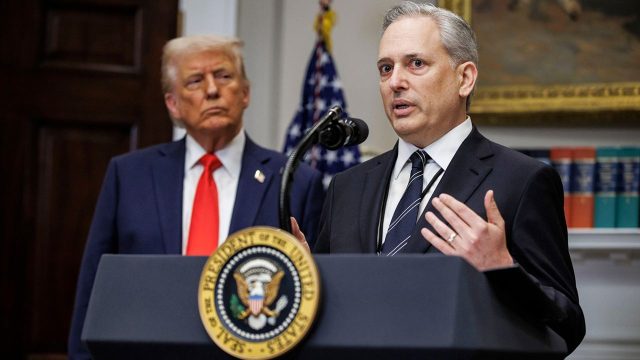
Trump ran on “America First,” said Dave Lee in Bloomberg. But on AI, he’s “Silicon Valley First.” Looming over Trump as he signed the order was a beaming David Sacks, the venture capitalist and White House “AI czar” who has been lobbying for a “moratorium” on state laws since last year. Why do Sacks and his fellow billionaires care if AI is regulated by states or Washington? Because they don’t want any regulation that might crimp profits— including safeguards to protect minors from suicide-encouraging chatbots—and they’re betting on “paralysis at the federal level” to ensure they don’t get any.
We need to take the AI threat from China seriously, said former defense secretary Chuck Hagel in The Atlantic, but state regulation is actually our best defense. The kinds of laws states are passing—to tackle “deepfake impersonation of public officials,” for example, or AI-driven phishing scams—are routinely minimized as “social issues” by Sacks and Co. But to China and other bad actors, weak regulations in these areas create precisely the kind of “soft targets” that could let them “distort elections, fracture alliances, and erode civic trust” within America. To preempt these laws in favor of federal oversight that doesn’t yet exist “would be a disaster.”
The outrageousness of Trump’s order is “one of the few things Republicans and Democrats can agree on right now,” said Tina Nguyen in The Verge. The Left is aghast at the naked profiteering, and the possibility that AI could wipe out jobs and further empower billionaires. And on the Right, MAGA icon Steve Bannon this week accused Sacks of having “completely misled” Trump by persuading him to back an “AI amnesty,” while Florida Gov. Ron DeSantis denounced “federal government overreach” that lets tech companies “run wild.” Bannon and DeSantis are channeling the real fears of red-state voters, said Valerie Hudson in the Deseret News. We saw what unregulated social media did to our children and our families. We’re not going to surrender and let Trump, or anyone, once again put the “pecuniary interests” of tech whiz kids and billionaires above “the lives and well-being of the American people.”
Trump launched a task force to challenge state laws on artificial intelligence, but regulation of the technology is under unclear jurisdiction