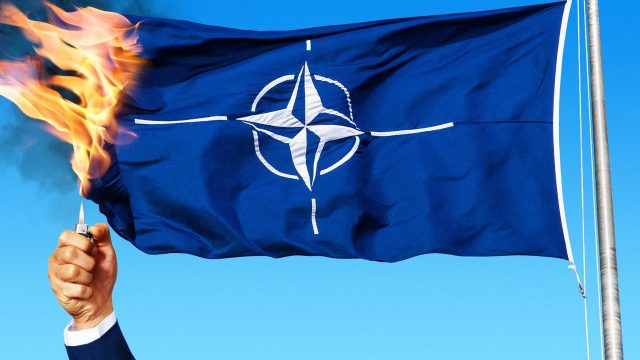
President Donald Trump loves raging against the North Atlantic Treaty Organization, regularly chiding the military partnership for alleged financial delinquencies while at the same time boosting the interests of NATO’s primary antagonist, Russia. Now, as America’s war on Iran continues, NATO’s ostensible neutrality in that conflict has prompted Trump to renew his threat of leaving the organization altogether. Trump often tries to dictate reality by presidential fiat, but the legal process for leaving NATO is largely out of his hands — and in Congress.’ The result is a Trump who is more constrained on paper, but not without a toolbox of other, less absolute options.
Why can’t Trump just quit NATO?
Trump has often threatened to leave the military alliance, but he has his own Secretary of State Marco Rubio to thank for the legal inability to do so. In 2023, Congress enacted “what appears to be the first statute prohibiting the president from unilaterally withdrawing from a treaty (specifically, the North Atlantic Treaty),” the government’s Congressional Research Service said in a February 2026 report. This “might be understood as a rejection” of the position that presidents possess “exclusive power over treaty withdrawal.”
The bill ensures presidents cannot exit NATO “without rigorous debate and consideration by the U.S. Congress with the input of the American people,” said co-sponsor Rubio in a statement on Senator Tim Kaine’s site; Kaine (D-Va.) was the amendment’s other sponsor. Before this, any member nation could exit the treaty one year after notifying the United States, which would then “inform the governments of the other parties of the deposit of each notice of denunciation,” the NATO charter said.
Per the bill, a bipartisan effort for which Rubio partnered with Kaine and others from across the aisle, a president may only exit NATO “by and with the advice and consent of the Senate, provided that two-thirds of the senators present concur or pursuant to an Act of Congress” — a virtual impossibility, given the Democrats’ current holdings in the upper chamber. The 2023 effort was “spurred by worries that Trump, if he returned to power, might try to quit the alliance,” The Washington Post said. Fast forward three years, and “Trump insists he’d be able to do it anyway,” said Deutsche Welle.
What can he do, then?
While it’s possible a constitutional challenge to Rubio’s 2023 bill “would likely favor the power of a president,” there are still “plenty of ways” Trump could “kneecap” the treaty “without leaving” or complying with the congressional restrictions, said DW. Even without an “official exit,” Trump’s “increasingly hostile stance toward the alliance may leave it weakened,” said CBS News.
If other member nations “can’t trust” that the U.S. will honor the treaty’s Article 5 mutual defense pact, then the “alliance is already broken in the way that matters most,” political scientist Ian Bremmer said on X. As soon as the group’s mutual defense pact is “questioned,” NATO “loses its potency” as a Russian deterrent, said Politico. Trump has, in that respect, “turned doubting NATO into official policy.”
Trump is also “considering a plan to punish” some NATO member nations he deemed “unhelpful” during the U.S.-Israeli attack on Iran, The Wall Street Journal said. This would involve relocating some of the 84,000 American troops stationed in Europe and deploying them to “countries that were more supportive” including Poland, Romania, Lithuania and Greece. Trump could also withdraw American military assets entirely and shut off funding for NATO operations. Or, if he wants “to be very dramatic,” Trump might even “decide not to staff the position of Supreme Allied Commander Europe,” a post traditionally reserved for American officers, said DW.
The president “could just downgrade our participation,” said Jim Townsend, a former Pentagon official who oversaw Europe and NATO policy, to Politico. He could choose to skip summits and the secretary of defense “won’t go to defense ministerials.” With the “language” of its 2023 bill, Congress has “prevented” a “total” and “formal withdrawal from NATO,” said Sen. Jack Reed (D-R.I.) to the outlet. But the United States could “still be in NATO” with a president grasping “many different levers” so that America’s impact would nevertheless “be diminished significantly.”
While an official withdrawal is unlikely, there’s still plenty the US could do to cut the decades-old security compact off at the knees