
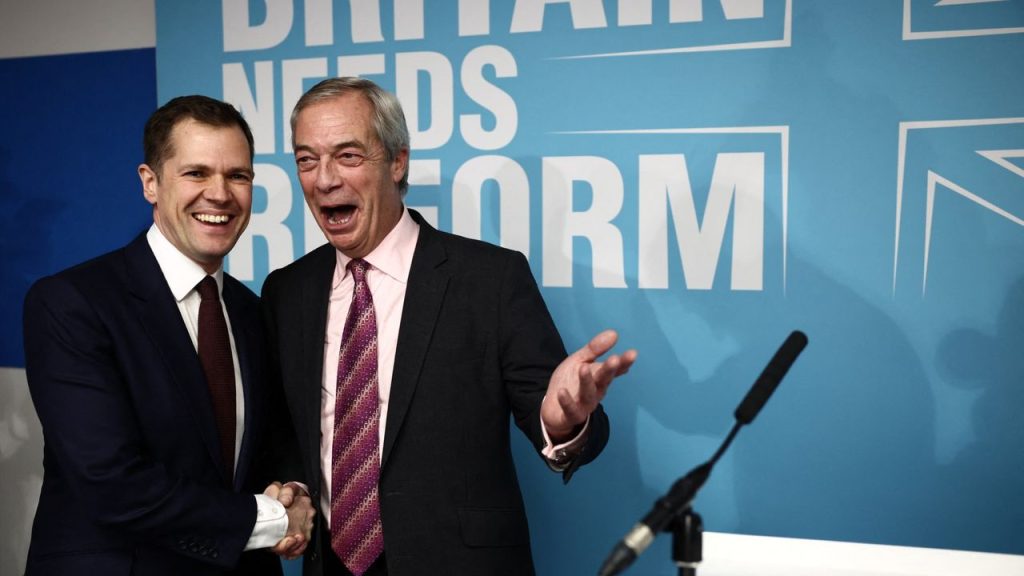
“The struggle for control of the British right” has taken a “dramatic turn”, said The Economist.
Robert Jenrick’s switch from the Conservative Party to Reform UK is “by far the most significant in a string of recent defections”, coming just 72 hours after Nadhim Zahawi made the same move.
“I am proud to be Reform’s 270,000th member,” said Jenrick in The Telegraph. “Both main parties broke Britain” and “the truth is Britain has been in decline for decades”.
But what does it mean for the party he left behind, the party he has now joined, and all political parties at the next election?
What does it mean for the Tories?
The Conservatives, often called the “most successful political party in the democratic world”, have a genuine fear of being “usurped by Reform UK”, said Henry Zeffman on the BBC. It is “inarguable” that the party is in a “massive mess”, but it will take time to tell whether its leader “triggering this mess was preferable to the alternative”.
Kemi Badenoch’s “swift manoeuvre” to oust Jenrick showed strength of leadership, sending out a message that the “embattled Tory leader is still up for the fight”, said The Economist. “If you squint” you can see her emerging well from this: “unencumbered by a troublesome rival” and with a “freer hand” to shape the party in her own image. Arguably, Jenrick could have been the victim of Badenoch’s growing stock in the party. “Or she might preside over the death of the world’s oldest and most successful political party.”
The Tory leader undoubtedly “projected strength”, but Nigel Farage “had the last laugh”, said Patrick Maguire in The Times. Jenrick’s defection once again raises existential questions for Britain’s oldest political party: should individual MPs “stick or twist”, and should the party “resist or reconcile?”
What does it mean for Reform?
Though bringing a sense of credibility, Jenrick also brings a “different dynamic” to the Reform/Farage “one-man band”, said Stephen Pollard in The Spectator. Not all members of the party will be “offering a welcome mat” to the former shadow justice secretary.
Jenrick’s move could lead to more defections and Farage has set a deadline of 7 May for those considering the move. “Reform has welcomed into its arms a politician who thinks nothing of changing his views overnight and stabbing his colleagues in the back and front,” said Pollard.
We may need to brace for infighting. “To say there is no love lost between Zia Yusuf, Sarah Pochin and others in the upper echelons of Reform and Jenrick” does a disservice to “the levels of pure hate displayed”. Given that representatives in the nascent party are jostling for positions of authority, “is Robert Jenrick really welcome in Reform?”
Reform could now have a leadership pairing similar to that in Washington, said Tom McTague in The New Statesman. “Reform’s latest recruit could be Nigel Farage’s answer to J.D. Vance.” Farage, like Trump, is a “formidable” politician who has captured the attention of the right, guided by “instinctive reactionary populism” rather than ideology. What Jenrick brings is a “project”, or a more “coherent plan” to reinvent the British state, because at the moment “there isn’t one”. Farage, much the same as Trump, may have “found an ideological foil”.
Farage was quick to thank the Tories for handing their “most popular figure” to him “on a plate”, but the jury is out on whether Jenrick will be a “help or a hindrance to Farage”, said the Financial Times.
The image of Reform may change. It could lose its cutting-edge or momentum, and instead become a “receptacle for disillusioned Tories” who are “relics of failed Conservative governments”. Farage will have to sacrifice some of his “decision-making” authority, now having to work “side by side” with a figure who has “made no secret of his desire to one day run the country”.
What does it mean for the right’s electoral prospects?
My defection will help “unite the right”, Jenrick told the BBC, attempting to quash the rumours that the move was motivated by personal ambition.
“In switching allegiances, Jenrick is helping to reshape British politics”, especially for the right, said the FT. Most significantly, he is “redrawing the battle lines over who will lead the right into the next general election”.
Jenrick’s defection “all-but ended the chances of any deal to unite the British right”, said Bloomberg. In all likelihood, this will lead to the “most widely contested” general election in years, as the traditional two-party system falls away. It is now increasingly unlikely that the Tories could “forge a pact with the insurgent Reform Party”, which has since “rapidly eclipsed” them in opinion polls.
Both Kemi Badenoch and Nigel Farage may claim victory, but Jenrick’s move has ‘all-but ended the chances of any deal to unite the British right’