The Trump administration has released lofty expectations about the state of the pharmaceutical industry, and not everyone appears to be a believer. Recent data from the White House predicted that the administration’s deals with drug companies could save the economy more than half a trillion dollars over the next decade. While Republicans are lauding this estimate, many Democrats are taking it with a grain of salt.
‘Touted his drug pricing deals as transformative’
The White House predicts that Trump’s deals could save $529 billion over the next 10 years, according to an analysis of data obtained by The Associated Press. The administration also estimated that federal and state governments could “save a combined $64.3 billion on Medicaid during the next decade” because of Trump’s deals, Josh Doak said at the AP.
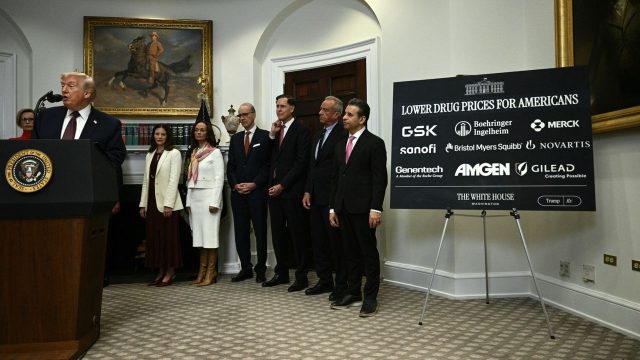
Trump administration officials have touted the president’s “drug pricing deals as transformative and urged Congress to codify their principles into law” as part of “most favored nation” (MFN) pricing, said Doak. The White House has “reached voluntary agreements with 17 pharmaceutical companies,” and it appears the administration’s “goal is to bring manufacturers of sole-source brand-name drugs and biologics into comparable arrangements,” Colleen Cabili said at Quartz. Details on the deal specifics remain unclear.
The president has “sought to position his pharmaceutical pricing push as a winning issue with voters,” said Cabili. Given his plummeting poll numbers over affordability, Trump has been “focusing on his efforts to cut deals with companies so that the cost of prescription drugs in the U.S. would no longer be dramatically higher than in other affluent nations,” said Doak.
The mechanism ‘remains a black box’
Despite the White House’s optimism, many across the aisle are skeptical of the Trump administration’s potential cost savings. Just prior to the White House’s analysis, 17 Democratic senators introduced legislation that would force Trump to provide details of the drug deals. If “these deals are actually lowering costs for patients, show us,” Sen. Mark Kelly (D-Ariz.), one of the co-sponsors of the legislation, said in a statement. “Americans deserve transparency.”
If “these deals are so great, why is the Trump administration afraid of showing them to the public? Because Trump is a giant fraud when it comes to lower drug prices,” Sen. Ron Wyden (D-Ore.) said in a parallel statement. The “scope of the savings claimed by the Trump administration are likely to intensify the scrutiny by Democrats,” said Doak at the AP. One of their primary concerns is that “pharmaceutical companies have increased their profit margins while working with the administration.”
The “exact mechanism” for these savings “remains a black box,” said Angus Liu at the biopharma news website Fierce Pharma. Beyond the price of the drugs themselves, the White House “has yet to define how commercial markets, such as employer-sponsored insurance, will access those discounted rates.” The “math for these massive savings only adds up if the administration can expand its circle of agreements beyond the 17 Big Pharma firms initially targeted” by Trump. Many biotech companies are also wary of “MFN’s impact on their business models” and “argue that they lack the diverse portfolios of pharma companies that can absorb revenue hits from pricing pressure.”
The Trump administration claims its deals could save over $500 billion