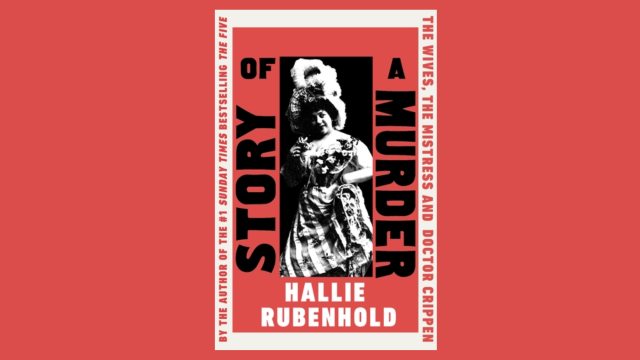
One night in 1910, an American quack doctor murdered his wife Belle Elmore, dismembered her body and buried it in the cellar of their north London home. He and his lover, Ethel Le Neve, then tried to flee to Canada, only to be foiled by a message sent from their ship via the new-fangled wireless telegraph; after a sensational trial, the doctor, Hawley Crippen, was hanged while Ethel walked free.
The story is, of course, a familiar one; yet in her new book, Hallie Rubenhold makes it exciting all the same, said Dominic Sandbrook in The Times. Rather than put Crippen centre stage, she focuses on his victim and his suspected accomplice: Belle, often depicted as blowsy and shrewish, is treated with gentle compassion, while Ethel is compellingly mysterious. The author also brilliantly evokes their milieu – the music halls in which Belle sang, the boom in homoeopathy that Crippen exploited, and the thrilling novelty of instant communications. It’s a “thoughtful, humane and gripping” book.
Rubenhold has delivered belated justice for Belle, said Jennifer Wright in The New York Times. Contemporary newspapers presented Crippen as a meek man driven to murder by a grand passion and an impossible wife. In fact, he ruthlessly exploited vulnerable people with his snake-oil cures; he forced his first wife, Charlotte, into multiple abortions and may have killed her too. He would almost certainly have got away with Belle’s murder but for her “fascinating” circle of bohemian friends – including a tightrope walker and a circus rider – and their determination to establish the truth.
This is a story of restlessness, aspiration and thwarted ambition, said Lucy Lethbridge in the Times Literary Supplement. The characters are perpetually on the brink of ruin or riches, changing their names at the drop of a hat: Crippen’s aliases included Cuppen, Franckel and Robinson. He emerges as a man “shaped by contradictions” – capable of small kindnesses and great charm, but also coldly calculating, with an eye for female vulnerability.
The book takes in a “dizzying” range of locations, said Nigel Andrew in the Literary Review, and the descriptions of these places rather clog the narrative. Where it really pays dividends is in its account of Belle and her music-hall career; but Ethel, too, springs to life as a woman whose ruthlessness matched her lover’s. Rubenhold reminds us of the “hideous” reality of murder and its ripple effect on family and friends, while providing the murdered woman with a fitting and “deeply sympathetic” memorial.
Hallie Rubenhold novel delivers belated justice to the victim of a 1910 London murder