
Lacy Baugher (Telly Visions) on BritBox’s Three Little Birds and the “post-Windrush story.”
BritBox’s Three Little Birds is not always an easy drama to watch. But it’s an important one. The 1950s-set period project hails from Black British comedian Sir Lenny Henry, who based the series on the stories of his mother and those like her who traveled to the U.K. as part of the Windrush generation. Workshopped with the help of Doctor Who’s Russell T. Davies, the series features “a warmth and heart that honors the thankless work of the Caribbean men and women performed who toiled to raise families and gain financial autonomy.”
In 1948, the British Nationality Act gave people from Commonwealth countries the right to live and work in Britain, as workers were needed to help counteract post-World War II labor shortages. The “Windrush generation” generally refers to those from the Caribbean — Jamaica, Trinidad, and Barbados, among other places — who traveled to work in Britain hoping for a new life and better opportunities for themselves. Many became manual workers, domestic helpers, drivers, and nurses in the newly established National Health Service. Named after one of the most well-known ships that facilitated these crossings (HMT Empire Windrush), this mass migration movement had a lasting effect on British culture and politics, yet it is infrequently explored in popular media, and it’s very likely many American viewers are unaware of this particular slice of history.
Three Little Birds aims to change all that. The series follows the story of three women — Leah, Hosanna, and Chantrelle — who arrive in England only to discover that the bright future they were promised on the other side of the ocean carries a bit more tarnish than they expected. The women face verbal and physical abuse, sexual harassment, professional inequalities, racism, and more. Yet the strength of the communities they build with one another helps them survive and learn to thrive in an unfamiliar and occasionally hostile land.
We spoke with Henry and Three Little Birds stars Rochelle Neil, Yazmin Belo, and Saffron Coomber about the universal nature of the series’ story, the power of focusing on an often underrepresented slice of British history, building their onscreen bonds together, and more.
Telly Visions: I think many Americans are probably not super familiar with the story of the Windrush Generation and everything that happened after the Empire Windrush came over. Tell me why you think it’s important to tell this specific story and to tell it in such a universal way.
Sir Lenny Henry: I think we hope the story resonates because there are all these shows—Avalon, Fresh Off the Boat—about immigrants moving from a place of privation and hardship and coming to a place where they get the opportunity to work in a different place, a different future. Perhaps a better future.
My family had British passports because Jamaica was a colony. We’re only here because they were there. And they arrived in this country to see signs that said “No Blacks, no Irish, no dogs” in all the windows. To be racially abused, and sexually abused, and oppressed by patriarchy. They had to work hard to overcome that stuff. And the way you do that is to form clusters, you form new families, a new support network. That’s what this series is about. And I hope we do it with a sense of joy and optimism. [. . .]
Neil: The thing with immigration is that everyone’s lives change. For the indigenous Brits, the Jamaicans or Caribbean people coming over, the food everyone was exposed to, the music everyone was exposed to, the culture… everyone’s lives changed, I think, for the better. I’m also a proud Brit, so… you’re welcome!
Henry: You can thank us for the seasoning later.
Neil: Exactly!
Henry: We brought culture. We brought seasoning. We brought flavor. We brought music, literature, and poetry; we contributed so much to this country. It’s worth celebrating. I wanted to do a series that wasn’t just about Black trauma. It was also about the success story of overcoming all these hardships, trials and tribulations. And yes, it’s the story of my parents and my family. But it’s also lots of people’s stories. You know—Rochelle, talk about your grandmother.
Neil: My grandmother wrote a memoir. I have a first-hand account of her life in Jamaica, meeting my granddad and having my dad and his siblings. She moved over here and then sent for them the same way that my character Leah did with her kids. On my mom’s side, my grandmother came over with her sister and her best friend. It’s uncanny how similar it all is. When I read the script, I was convinced Lenny had been following us around. It’s so many people’s stories. [. . .]
For full article, see https://tellyvisions.org/article/three-little-birds-interview-lenny-henry-rochelle-neil-yazmin-belo-and-saffron-coomber
Also see https://www.wgbh.org/tv-shows/drama/2024-02-08/britboxs-three-little-birds-expands-the-view-of-black-history-month and https://www.ebony.com/drama-series-three-little-birds-racism-uk
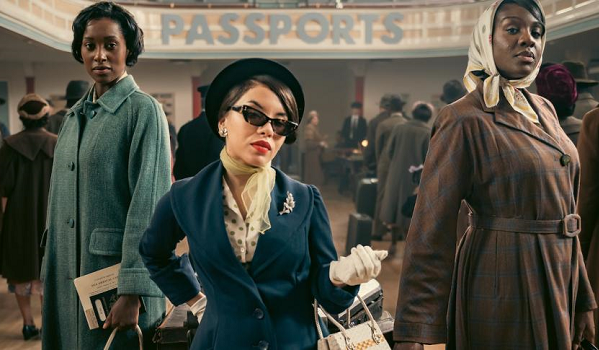
[Photo above: Rochelle Neil, Saffron Coomber, and Yasmin Belo in “Three Little Birds.”]
Lacy Baugher (Telly Visions) on BritBox’s Three Little Birds and the “post-Windrush story.” BritBox’s Three Little Birds is not always an easy drama to watch. But it’s an important one. The 1950s-set period project hails from Black British comedian Sir Lenny Henry, who based the series on the stories of his mother and those like her who traveled to the