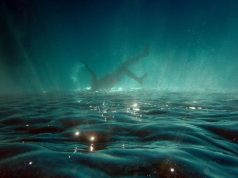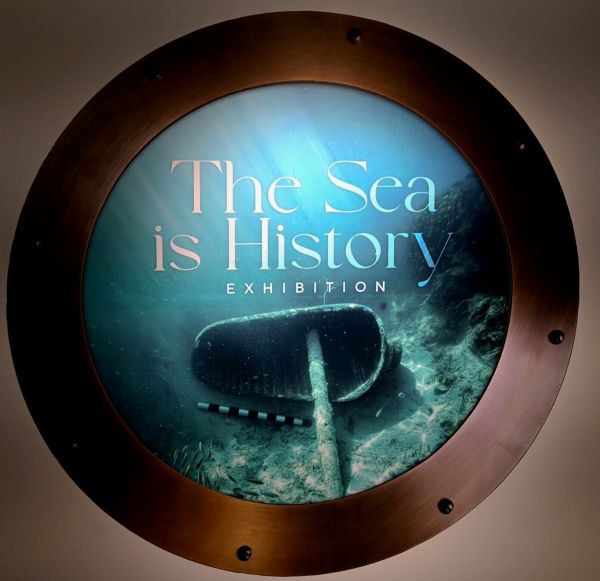
[Many thanks to Veerle Poupeye (Critical.Caribbean.Art) for bringing this item to our attention.] Christopher Tobutt (Cayman Compass) reviews “The Sea is History,” presently on display at the Cayman Islands National Museum until the end of February. Inspired by Derek Walcott’s iconic poem, “The Sea Is History” explores the sea “as the keeper of Caymanian memory — a witness to our history, identity, and way of life.” For complete review, visit the Cayman Compass.
Step into the Cayman Islands National Museum’s exhibition ‘The Sea Is History’, and it becomes clear that this isn’t an art show in the polite, gallery sense. It’s a confrontation with the ocean that shaped Cayman long before tourism, long before modernity, long before anything was written down.
The first thing you feel is that the sea has followed you indoors. Not the sound of it, exactly, but its presence – a breath, a weight, a memory.
The exhibition borrows its title from Derek Walcott, and the museum notes the opening stanza “powerfully evokes the role of the sea in Caribbean identity”. But the poem doesn’t sit on the wall like literature. It drifts in like a ghostly voice, nudging the visitor’s consciousness. The sea has locked them up; it murmurs the stories no monument ever held. Another echo rises later, softer: Nothing was written down … everything was carried by the waves.
The objects here aren’t precious because they’re rare. They’re precious because they survived, like a length of thatch rope worn down to a whisper. Old sepia photographs of Cayman built schooners from the first half of the 20th century — proud vessels made by hand, plank by plank, by men who trusted their craft and feared the sea in equal measure. These aren’t relics of an artistic tradition; they’re fragments of a working life.
There’s an old metal and glass diving helmet, found washed up on a local beach sometime in the 1980s or ’90s. Heavy, rounded, almost alien now, it would have been similar to the kind worn by Cayman diving pioneer Bob Soto in his earliest years underwater. Before scuba, before tourism, diving was dangerous, physical labour. The helmet feels less like an artefact and more like a memory the sea decided to return.
Nearby, a turtle decoy from the early 1900s rests in quiet dignity. A simple carved form – no detail, just the essential shapes: shell, head, flippers. It’s art, yes, but really, it’s art because it’s a tool of survival. A fisherman carved this not to express himself, but to feed his family. The integrity of the exhibition lies in moments like this, where beauty and hardship are the same thing.
Turn a corner and a Gordon Solomon painting, ‘The Middle Passage’, confronts the viewer with a cutaway sea, cold grey sky and luminous red water. Silhouettes of enslaved Africans sink in chains, linked like a macabre daisy chain. The painting doesn’t dramatise; it simply shows what the sea remembers. And somewhere behind you – or perhaps inside you – the whisper returns: The sea is history. [. . .]
For full article, see https://www.caymancompass.com/2026/02/04/the-sea-is-history-provides-a-powerful-reminder-of-caymans-identity/
Also see https://www.museum.ky/ and https://caymanindependent.com/exhibition-explores-relationship-between-cayman-and-the-sea/
[Many thanks to Veerle Poupeye (Critical.Caribbean.Art) for bringing this item to our attention.] Christopher Tobutt (Cayman Compass) reviews “The Sea is History,” presently on display at the Cayman Islands National Museum until the end of February. Inspired by Derek Walcott’s iconic poem, “The Sea Is History” explores the sea “as the keeper of Caymanian memory