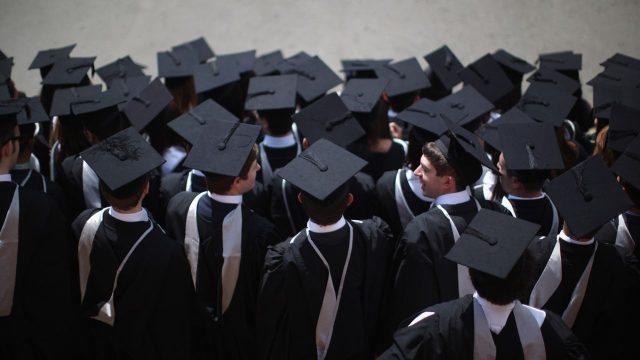
Many graduates who took out student loans feel they got “an incomprehensibly unfair deal that they did not understand and now cannot escape”, says John Blake, formerly of the Office for Students. The problems are worst for the estimated 5.8 million people who took out “Plan 2” loans, the main scheme from late 2012 to mid 2023. While the interest rate on other loans is set at the Retail Prices Index (RPI) measure of inflation, Plan 2 loans are charged at RPI plus up to 3%.
Then at the last Budget, Rachel Reeves froze the threshold at which repayment in England starts between April 2026 and 2030; it was meant to rise with inflation. This means that more people will have to pay, while interest has snowballed, even for those with hefty monthly repayments. The result is a large cohort of angry indebted graduates.
How do Plan 2 loans work?
They were introduced for students in England and Wales in 2012, after the coalition government tripled tuition fees from £3,290 to £9,000 per year (there are no fees for students from Scotland, and they’re capped at about half the rate in Northern Ireland).
While studying, each borrower was charged interest at the RPI rate plus 3%. Afterwards, it moved to tiered rates starting at RPI, rising up to RPI+3%, depending on earnings (those making £51,245 or more currently pay the full rate). However, borrowers don’t have to pay anything until they reach the repayment threshold, now set at £28,470. Then they pay back 9% of their earnings above the threshold. After 30 years, any outstanding balance is written off.
How does this affect people in practice?
To take one example, Patrick Ba Tin, 30, borrowed some £50,000 in student loans – around average as a total – and was told he would hardly notice the repayments. Now a regulatory analyst earning a decent wage, Ba Tin has paid £5,000 towards his loans since graduating, with the current rate at £300 per month. Even so, the loan is actually growing: he now owes £75,000 in total; he will probably have to keep paying for the full 30 years. Of course this affects his finances, and his ability to buy a home. A typical graduate from the Plan 2 cohort has to earn at least £66,000 a year just to make his or her debt go down. Nadia Whittome, a Labour backbencher, has only managed to pay off £1,000 of her £49,600 debt despite six years on an MP’s salary. And repayments come on top of already high tax rates. So a Plan 2 loan holder earning £51,245 will take home only 49% of their earnings above that.
How have loans changed since?
Plan 5 student loans replaced Plan 2 for courses starting in August 2023. These don’t charge interest above the rate of inflation: the rate simply follows the RPI. But borrowers have to start paying them back sooner – the repayment threshold is only £25,000, not far off the minimum wage – and the repayment term is ten years longer: 40 years. Under this system, in contrast to Plan 2, no one will have to pay back more than they borrowed in real terms, and the Institute for Fiscal Studies estimates that 79% of initial borrowers will repay their loans in full. However, lower earners will pay more and higher earners less than they would have under the previous system. Plan 5 will also be costlier for the taxpayer in the long run.
Is the system unfair?
It is harsh for holders of Plan 2 loans. A loan holder who started a course in 2022 will pay around £8,700 more on average than someone who took one out a year later. Tinkering with the repayment threshold, by Conservative and Labour governments, has made repayments unpredictable.
The finance guru Martin Lewis has called on Reeves to reconsider her repayment threshold freeze, saying it isn’t “moral” to change the terms of a loan; polls suggest half of Plan 2 loan holders think the product was “mis-sold” to them. The National Union of Students and The Times have also called for an end to the freeze, along with cuts to the Plan 2 interest rate and a cap on the total amount of interest payable. Arguably, the RPI measure shouldn’t be used at all: the government is phasing it out – because it is deemed about 1% too high – in favour of the Consumer Prices Index (CPI).
Beyond that, there is the wider issue of inter-generational unfairness. The Plan 2 cohort were the first to be hit with substantial tuition fees, which were not charged at all until 1998. In addition, young people face high property prices, and governments that arguably protect the finances of pensioners at the expense of younger generations.
Can Plan 2 loans be defended?
They are in some respects generous, and more like a graduate tax than a bank loan. They do protect low earners; and during the ultra-high inflation period after Covid, the government intervened to cap interest rates. More broadly, the student loan system reflects important trade-offs. Britain has a mass university system – some 50% of young people in the UK go into higher education – and it has to be paid for somehow. All the main parties in England have decided that those who benefit most directly – well-paid graduates – should bear much of the burden. The costs are considerable: the total outstanding Plan 2 debt is about £200 billion.
What is likely to happen?
Reeves has insisted that the student loans system is “fair and reasonable”, and that the freeze was necessary for getting “the balance right between tax and spending”. But sources suggest discussions are taking place about possible measures to make the loans fairer, perhaps by tweaking interest rates. Kemi Badenoch has announced that the Tories would abolish the “unfair” additional interest, at the cost of some £2 billion per year, paid for by cutting funding for “low-quality degrees”. But this – unlike raising the earnings threshold – would only benefit those earning enough to clear the debt within 30 years.
Is a graduate tax the solution?
The idea of funding universities with a graduate tax has been mooted since the 1960s, when economists pointed out that a relatively small group of people were getting an expensive benefit paid for out of general taxation. The idea came up again during the expansion of higher education in the 1990s, and at one time or another it has been backed by the likes of Gordon Brown and Vince Cable. In practice, the loans function much like a tax – repayments are collected through the tax system – and proponents argue that presenting them with a future tax obligation is less stressful than being saddled with a large debt.
Implementing a tax would raise major administrative issues, though. There is no register of graduates. And might it incentivise students not to graduate? Or encourage high-earning graduates to move elsewhere? There are already problems in this area: at least 70,000 loan holders living abroad were reported not to be making repayments in 2024. No country in the world imposes a pure graduate tax, though many use income-contingent loans. The UK loans are high, though, since people here contribute more to their education: only 23% of higher education is paid for by public funding in the UK, well below the OECD average of 67%.
Millions of graduates have been left with hefty student loans, at high interest rates