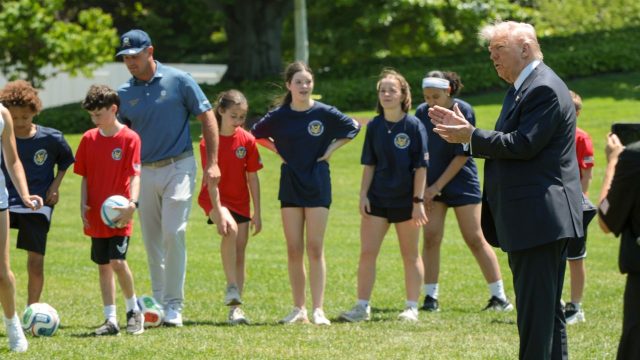
The Trump administration has officially brought the Presidential Fitness Test back from the dead after it was discontinued in 2013, and Secretary of Health and Human Services Robert F. Kennedy Jr. is lauding it as a major step forward for children’s health. But some health experts aren’t so sure that the revitalized test will improve youngsters’ lives in a meaningful way.
‘Not much has changed’
The test, which was sunsetted during the Obama administration in favor of a different regimen called the Presidential Youth Fitness Program, is now back by executive order from President Donald Trump. But “compared to previous iterations of the test, not much has changed: It includes a timed run, an upper-body strength test, and a core test, with benchmarks set by a child’s age and gender,” said Chelsea Cirruzzo at Stat News. Health experts worry that such a stringent “focus on specific physical activity benchmarks could turn some kids off exercise.”
The “worst experiences that people tend to report are something having to do with embarrassment,” Matthew Ladwig, an assistant professor of integrative human health at Purdue University Northwest, told Stat News. Negative memories of exercise as a child are “associated with adult sedentary behavior” later in life, a 2018 study co-authored by Ladwig found. Embarrassment is a “leading indicator. A lot of people felt that with the old test, which, unfortunately, shares a lot of similarities with the new one.”
Others question “whether a fitness test alone will be enough to move the needle on physical activity and exercise,” said Mary Kekatos at ABC News. “When you think about a math test and English test, it’s private failure. If you don’t do very well on a test, the teacher knows and you know, but the rest of your classmates don’t know,” Jackie Goodway, a kinesiology professor at Michigan State University, told ABC. “But if you come in last in the mile run and everybody’s laughing at you, it’s public humiliation.”
‘A healthy nation can only exist if its citizens are fit’
Others believe that the physical promises of the Presidential Fitness Test outweigh any negatives. A “healthy nation can only exist if its citizens are fit,” and “policymakers are finally recognizing the problem,” said K. John Lee at The Oklahoman. The reimplementation of the exam comes at a time when many children can “not currently pass a military physical fitness test,” and “whether or not a student ever serves in uniform,” that “should concern us.”
“Too many young people are spending less time moving and building healthy habits,” said Rep. Jeff Van Drew (R-N.J.) in a statement. Reviving the test will “give students a positive goal to work toward and make physical activity a bigger part of their everyday lives.” By “bringing back the Presidential Fitness Test,” said Kennedy in the same statement, America is “giving parents, schools, and communities the tools to help children build healthy habits, strengthen their bodies, and discover what they’re capable of achieving.”
On its own, a physical test would be more of a “performative gesture than a real public health campaign to tackle the childhood obesity epidemic,” The Washington Post editorial board said in an August 2025 op-ed, after Trump announced the test’s return. But a “focus on the health of America’s children is welcome, especially if it draws added attention to the need for more school time devoted to physical activity.”
The test has been reinstated after being canceled in 2013