
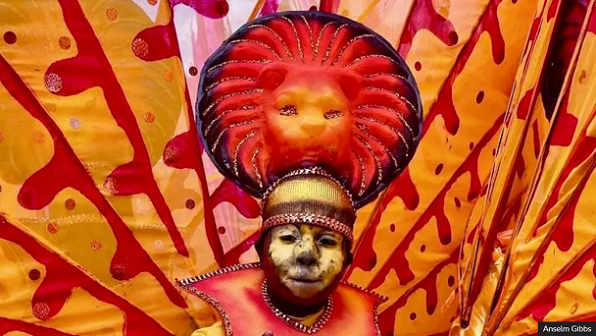
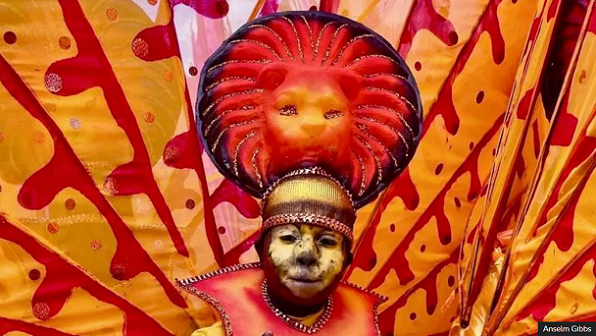
Anselm Gibbs (BBC News) writes that “Carnival costumes are elaborate affairs at what many dub ‘the greatest show on Earth.’” He underlines community efforts to make Carnival and related events more sustainable.
From dazzling costumes to exuberant parties, Trinidad’s carnival is often dubbed “the greatest show on Earth”.
But some of its elements are not exactly eco-friendly and the festivities are estimated to produce 3.4 tonnes of waste every year according to Carnicycle, a local initiative aiming to make festivities more sustainable.
Danii McLetchie, who co-founded Carnicycle in 2018, says that while carnival “is a big part of our culture” it also has a very negative environmental impact “from the events, to the textiles, to costumes” used by the masqueraders, spectators and vendors taking part in the annual parade on the two days preceding Ash Wednesday.
Producing and transporting just a single carnival costume bra can generate approximately 37.68kg (83lb) of CO2 emissions, Carnicycle estimates based on calculations made using an online tool provided by Swedish tech company Doconomy.
Danii and her team are working to have that estimate verified by a third party, but with tens of thousands of masqueraders parading every year, she says the amount of emissions is cause for concern. To reduce those emissions, Carnicycle has started a recycling programme, collecting unused costumes that would have been dumped or burned by masquerade bands, which use new costume designs every year. Carnicycle also puts up collection bins at hotels and other venues so discarded costumes can be reused. [. . .] The salvaged materials are sold to costume designers, ravers, and people in the burlesque industry, who save by buying second hand.
Danii and Carnicycle’s co-founder Luke Harris – who both hold down full-time jobs in addition to their environmental initiative- are not the only ones dedicating their spare time to making Trinidad’s carnival both fun and eco-friendly. [. . .]
Lawyer Aliyah Clarke and fashion designer Kaleen Sanois started a side business called 2nd Closet – a pop-up thrift shop where people can buy and sell pre-owned clothing. The two have also been making video tutorials with tips on how to transform costumes into beachwear and outfits for other occasions. [. . .] They also offer a closet-sorting service, which involves coming to a person’s home and sorting through unwanted clothing, to rescue items fit for sale at their pop-up thrift shop. [. . .]
“Over the past three years we’ve actually prevented over one million single-use plastics from entering the landfill, I think maybe over five tonnes of glass,” says Vandana Mangroo, co-founder of Close the Loop Caribbean, a company which started working with the organisers of Fete with the Saints in 2023 to make the event more sustainable. [. . .]
For full article, see https://www.bbc.com/news/articles/ckgy421gmy2o
Anselm Gibbs (BBC News) writes that “Carnival costumes are elaborate affairs at what many dub ‘the greatest show on Earth.’” He underlines community efforts to make Carnival and related events more sustainable. From dazzling costumes to exuberant parties, Trinidad’s carnival is often dubbed “the greatest show on Earth”. But some of its elements are not