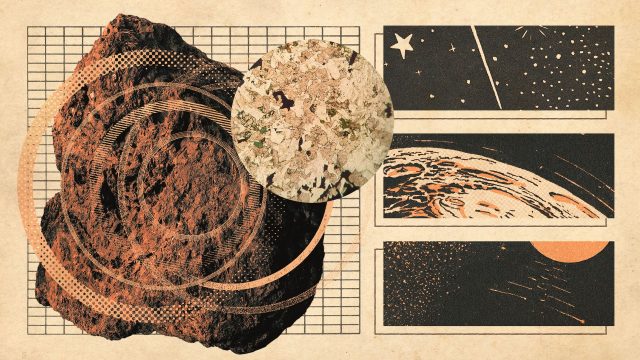
A 4.1-billion-year-old Mars meteorite discovered in the Sahara Desert has a “composition, mineralogy and texture” that’s “distinct from other Martian meteorites,” said a study published in the journal Science. It could provide insight into the geographic history of the red planet and Earth.
A new stone to turn
The meteorite, named Teghaza 001 after the salt plain in Mali where it was found, is “really our first piece of Martian crust from a part of Mars we have never had a sample of before,” said study author Lee Saper in a NASA release. Other Mars meteorites are usually about 2 billion years younger, a fact that “has long vexed scientists,” as previous observations have “dated much of the planet’s surface to be over 3 billion years old,” said The Washington Post. “
Also unlike other Mars meteorites, Teghaza 001 has a “mix of igneous minerals that tells a story about how the planet’s crust formed from cooling magma before it was eventually altered by subsurface water,” said the release. Researchers analyzed the sample and determined it must have formed “roughly within the first 400 million years of Mars’ existence,” said CNN.
What’s left unturned
Analysis of the meteorite shows that “early Mars may have had a more dynamic water cycle than scientists previously believed,” said CBS News. Teghaza 001 “records interactions of water and rock and maybe even an imprint of the Martian atmosphere as it was losing water,” said Saper in the release.
These findings could have broader implications for “understanding the habitability of planets,” said study co-author Hayward Melton to CNN. The meteorite is providing a “deeper understanding of not only early Mars but also Earth” and can help us learn why Mars “became dry while the Earth did not.”
Mars and Earth “formed in similar ways, with giant magma oceans that cooled into cores, mantles and crusts,” said Scientific American. Because of its “tectonic activity,” the Earth’s surface “does not preserve many (if any) samples from its primordial youth.” But Mars is different and can serve as a contrast. The research has “only scratched the surface,” said study lead author and NASA scientist Yang Liu in the release.
The rock may have formed early in Mars’ history