
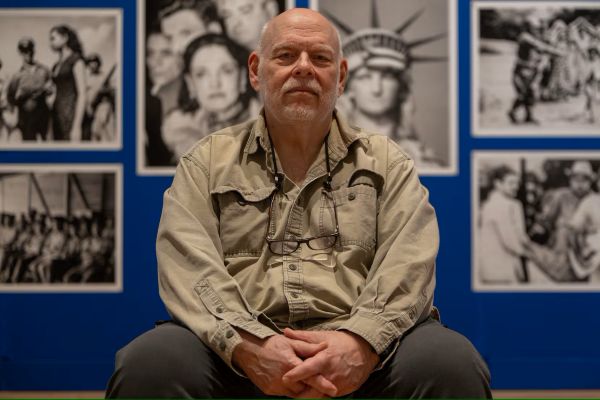
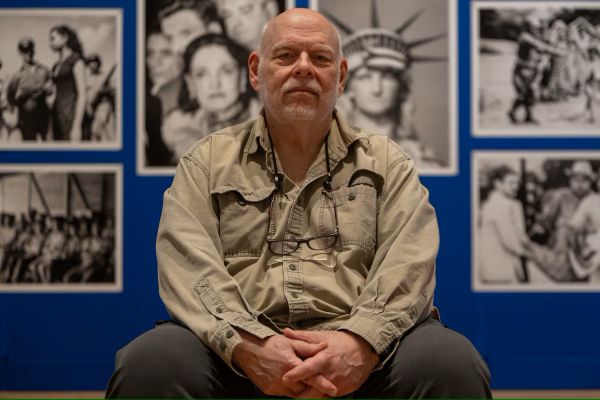
The full title of this article by Itzel Rivera (El Nuevo Día) is “’The Museum of the Old Colony,’ a Puerto Rican historical memory installation that calls for decolonization, arrives in Connecticut.” Here are excerpts from Rivera’s review of Pablo Delano’s work.
Presented in various countries, Pablo Delano’s installation works as a moving archive that questions the narrative of the island as it is constructed abroad.
Visual artist and photographer Pablo Delano grew up in Puerto Rico in an artistic environment. His parents, graphic designer Irene Delano and photographer Jack Delano—who was born in Ukraine—moved to the island in 1946 and were key figures in the development of cultural projects and social documentation of the U.S. territories.
Delano was surrounded by this legacy, as well as a community of artists, photographers, and filmmakers close to his family who shaped his understanding of visual history. Although he later moved to the United States to pursue a career as a painter, the conceptual turning point in his work came with the creation of the Fiscal Oversight Board in 2016, an event that reignited his reflections on autonomy.
Added to this were the interests of a photographic essay on Trinidad and Tobago, an island he visited in 1996, which prompted him to explore its postcolonial society and how “a country grapples with decolonization and struggles to define itself.”
That cultural heritage and political context were the catalysts for “The Museum of the Old Colony,” a conceptual installation that uses a wide selection of images and objects to confront the legacy of “American colonialism” in Puerto Rico since 1898.
A Popular Soft Drink
Like many Puerto Ricans, Delano grew up with an everyday reference point that at the time seemed innocent: the Old Colony soft drink. “We grew up drinking it without thinking about the meaning of the name. At first, it was like… Yes, we’re the oldest colony in the world, and there it was, on the can with a soldier on the label,” Delano reflected during a tour with El Nuevo Día and Connecticut Public Radio. [. . .]
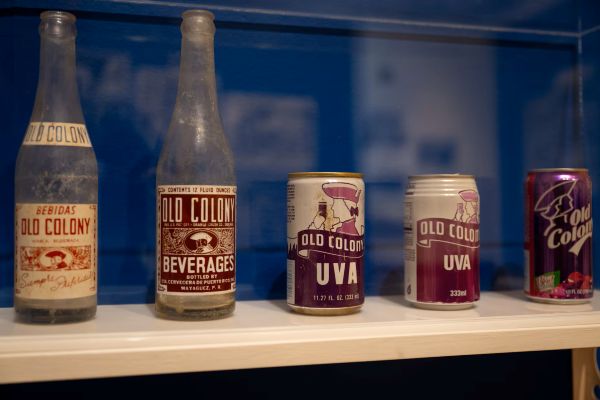
The work is currently housed at the New Britain Museum of American Art in Connecticut, and it has already been exhibited in Puerto Rico, Trinidad and Tobago, Venice, Argentina, and New York—among other places—and is on its way to São Paulo, Brazil.
Although it was initially shown at the Museum of Contemporary Art [in Puerto Rico], Delano believes the ideal scenario would be for the entire work to have a permanent home on the island. “I don’t think about the legacy. What I would like is for this to end up in Puerto Rico, where it belongs,” he concluded after defining his work as a “call for decolonization.”
The museum is not presented as a historical exhibition or a linear tour, but rather as fragmented visual modules that compel the visitor to “interpret” and that, depending on the location and space, “evolve.” [. . .]
Delano recalls that at his parents’ house there was the book “Our Island and Their People,” an 1899 text composed of photographs of Puerto Rico and its people, the captions of which reflected a “completely dehumanizing” colonial perspective. “There were some that people couldn’t believe were real,” he explained, which led him to digitize part of the material to archive the descriptions that placed the island’s rural population within racial hierarchies.
On a table in the installation, this and other books—with green covers—are arranged to form a silhouette of Puerto Rico. Small toy soldiers appear on them, alluding to the remilitarization of the island and Vieques.
Other sets emphasize the repetition of historical patterns in Puerto Rican life, especially waiting. For example, some photographs show citizens lining up at the Military Service Registration Board for World War II and women lining up for jobs at the International Resistance Enterprise Subsidiary. Meanwhile, there are images of thousands lining up for gasoline during Hurricane Maria in 2017. Opposite these photos are others depicting the largest wave of Puerto Rican migration in the mid-20th century: Puerto Ricans lining up to board a plane bound for Michigan.
Below them is a suitcase on a scale that reads 51 pounds, a symbolic reference to the number of pounds Puerto Rico would occupy if it became a state, to displacement, and to the Puerto Rican diaspora. [. . .]
Excerpts translated by Ivette Romero. For original article (in Spanish), see https://www.elnuevodia.com/entretenimiento/cultura/notas/the-museum-of-the-old-colony-una-instalacion-de-la-memoria-historica-de-puerto-rico-que-hace-un-llamado-a-la-descolonizacion-llega-a-connecticut/
[Photos by Tyler Russell/Connecticut Public Radio. For complete photo gallery, see https://www.elnuevodia.com/entretenimiento/cultura/notas/the-museum-of-the-old-colony-una-instalacion-de-la-memoria-historica-de-puerto-rico-que-hace-un-llamado-a-la-descolonizacion-llega-a-connecticut/]
The full title of this article by Itzel Rivera (El Nuevo Día) is “’The Museum of the Old Colony,’ a Puerto Rican historical memory installation that calls for decolonization, arrives in Connecticut.” Here are excerpts from Rivera’s review of Pablo Delano’s work. Presented in various countries, Pablo Delano’s installation works as a moving archive that