
How has Mississippi improved?
For years, Southern states with struggling education systems could console themselves: No matter how poorly they were doing, they weren’t as bad as Mississippi. Just 12 years ago, Mississippi ranked 48th in K-12 education, based on metrics like attendance, reading proficiency, and on-time graduation. Now the state is no longer a punch line. It’s up to 16th in K-12 rankings and has achieved particular success in fourth-grade reading comprehension, jumping all the way to the top 10 in the National Assessment of Education Progress (NAEP). When adjusting for poverty and other demographic factors, Mississippi actually tops the nation in that category. Crucially, improvements are seen among students at all reading levels, “rather than just among higher achieving or lower achieving students,” says Dan McGrath, a retired federal education official who oversaw the tests. “It’s as if Mississippi had moved a mountain.” And it did this despite spending just $12,000 per student, much less than the national average.
What did it change?
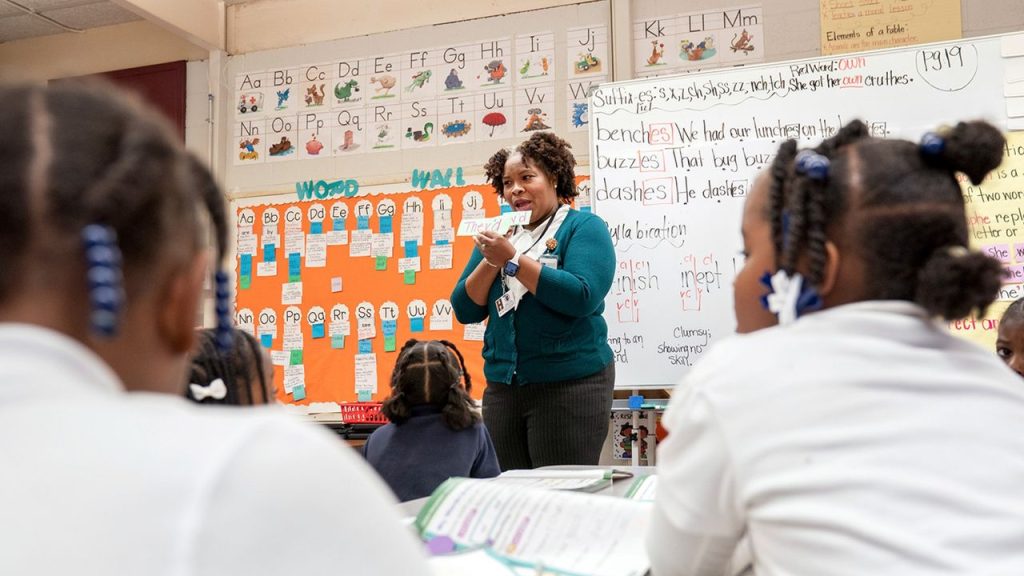
Mississippi passed the Literacy-Based Promotion Act in 2013, paving the way for implementing the “science of reading” in K-3 classrooms. This multifaceted approach—which involves teaching phonics, word recognition, vocabulary, and text comprehension—gets much of the credit for the state’s turnaround, but it’s just one tenet of the law. Accountability, from both students and schools, is another. Mississippi grades its schools A to F and sends coaches to train teachers in low-performing ones. Students get to see and track their own testing data. “I like it,” one pupil, Johnny, told The New York Times. “If I make a bad grade, but I’m going up, it’s like a staircase.” At the end of third grade, those who don’t pass a literacy exam after multiple attempts are automatically held back. That “third-grade gate” has drawn praise as a tough but beneficial rule that’s paying off: a record 77.3% of third graders passed the initial administration last year. Yet it also has its share of critics.
What do they say?
They say Mississippi has stacked its deck. Of course all the fourth graders can read, they say—the kids who couldn’t were kept back in third grade. In 2023, fully 7% of Mississippi third graders, over 2,000 kids, were held back. One study in the statistics journal Significance said Mississippi’s approach amounts to “gaming the system.” Others point out that Mississippi scores didn’t even improve much, it’s just that other states got worse. Still, some research indicates that something real is happening. A Florida State University study found compulsory grade repetition alone can’t explain higher test scores. Mississippi’s literacy gains have also remained consistent across every decile on the NAEP exam. A 90th-percentile score, for instance, leaped from 249 in 2005 to 262 in 2024, and a 10th-percentile score from 157 to 170. Andrew Ho, a testing expert at Harvard, told ChalkBeat that he doesn’t “see any smoking guns or red flags” around Mississippi’s success. That’s why other states are starting to copy it.
What are other states doing?
Across the South, states from Louisiana to Virginia have adopted at least some of Mississippi’s strategies, including teacher-training methods, curriculum reform, and high standards. Florida, Indiana, North Carolina, and Oklahoma have even copied the third-grade gate approach. Now Louisiana leads the country in recovery from pandemic-related losses in reading, while Alabama takes the crown for math recovery. These states particularly shine when NAEP scores are adjusted for demographics. After considering factors like poverty and race, the Urban Institute think tank determined, Mississippi tops the nation in fourth-grade reading, fourth-grade math, and eighth-grade math, and it’s fourth in eighth-grade reading. Still, not everyone is satisfied with Mississippi’s middle-school progress.
What happened in middle school?
If you don’t adjust for demographics, Mississippi eighth graders rank a dismal 41st in reading. Things are getting better—between 2013 and 2022, its eighth graders cut their gap with the national average in half—but the pace has been slower than in lower grades. That’s hardly a surprise, since the 2013 law focused specifically on improving early-education literacy. The state hasn’t invested the same time, money, and resources into middle-school reading, the time when literacy instruction shifts from “learning to read” to “reading to learn.” Critics say Mississippi needs to ensure that older children can read—and that students’ math skills get the same attention as their reading skills.
Is the state planning to do that?
Mississippi is now looking to pass a bill that would expand the 2013 literacy reforms into higher grades. The teachers tend to appreciate the help from literacy coaches, Mississippi education official Tenette Smith says. “We hear from teachers and administrators who say, ‘I didn’t know what I didn’t know.’” The state also seeks to adopt similar reforms for primary-school mathematics, mandating math coaches in all schools, prioritizing grades 2-6, and placing a cutoff gate for fifth grade so that only students who are ready will move on to sixth-grade algebra classes. Pilot programs are already underway to improve reading comprehension in upper grades. While it’s too soon to tell whether those efforts will pay off longterm, the early test results are promising. The Mississippi miracle is “proof positive that, yes, children in poverty can learn and can succeed,” said Carey Wright, Mississippi’s former superintendent of education. “As educators, our job is to do whatever it takes.”
The Magnolia State has leapfrogged ahead in youth literacy. Can it be a national model?