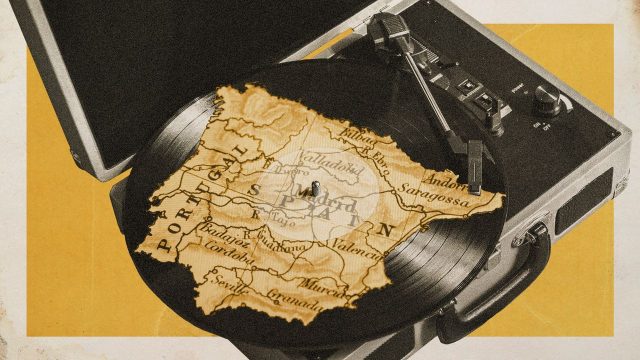
Spain and Portugal are taking a turn. The Iberian Peninsula sits on a boundary between two large tectonic plates that are being stressed by a variety of forces, and because of this, the peninsula is turning clockwise very slowly. A noticeable shift of the land is still far off, but understanding the dynamics can help us even today.
Turning point
Using earthquake records and satellite observations, scientists were able to match patterns of earthquake stress with estimates of strain on the Earth’s surface to determine that the Iberian Peninsula is rotating, according to a study published in Gondwana Research. The Earth’s crust is “fractured into portions that float and move on a nearly liquid and ductile lower mantle,” called tectonic plates, said El Pais. Their movement is “what causes continents to move closer together or farther apart, and seas to close or open,” as well as “tensions that are eventually released in the form of earthquakes and volcanic eruptions.”
The Earth’s continents and landforms are always changing thanks to the tectonic plates. “Every year the Eurasian and African plates are moving 4–6 mm closer to each other,” Asier Madarieta, a researcher at the University of the Basque Country and the leader of the study, said in a statement. The boundary between the plates “behaves more like a zone of distributed stress, with different forces competing to shape the Earth’s crust,” rather than a “single clean fault line,” said Discover.
Specifically, in the western Mediterranean, “plate motion is dominated by a tectonic region known as the Alboran domain, which is drifting westward,” said Discover. This drives the formation of the Gibraltar Arc, a “curved mountain belt that links southern Spain’s Betic Cordillera with Morocco’s Rif Cordillera.” Because of this, different parts of the boundary behave differently. “Some areas are already dominated by direct collision between Eurasia and Africa, while others are still shaped by the westward motion of the Gibraltar Arc.” In turn, this “could affect the stresses being transmitted to the southwest of Iberia, by pushing Iberia from the southwest and making it rotate clockwise,” Madarieta said.
Full circle
We will not see the effects of the spinning peninsula for a long time. “From the viewpoint of our nanosecond-long human lives, the Iberian Peninsula remains unchanging, but this slow geologic work will take place over many millions of years,” said Popular Mechanics. Despite this, there is still great value in understanding how these tectonic plates move and change. Researchers “hope to develop a detailed overview of the geometry of these faults and folds and understand what potential earthquake threats may lurk there,” especially with the study’s “new view of the stress and deformation fields.”
Even though it is far in the future, the “very long-term consequences will be enormous,” said El Pais. The “Mediterranean will once again become a closed sea, Africa and Europe will be joined to the west and what is now southern Iberia will either face the Americas or will have merged with the area of Ceuta, a Spanish exclave in North Africa.” Going forward, the “data will increase exponentially,” said Madarieta. “We will be able to calculate the deformations in more detail, even in the places where we have little information available.”
We won’t feel it in our lifetime