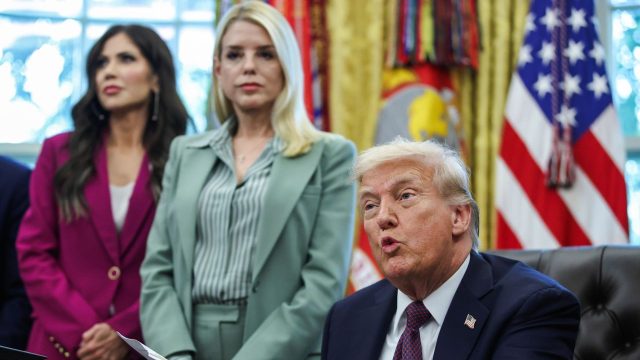
President Donald Trump’s first term in office was marked by the cyclonic speed with which his White House’s revolving door spun for aides both incoming and outgoing. During his second term, Trump’s penchant for abrupt staffing changes has continued — if not apace, then at least with the same mercurial fickleness that characterized many of his first-term firings. Here’s who has already been shown the exit, shuffled into a new role or been given little choice for their continued employment in the administration.
Attorney General Pam Bondi
Trump’s early-April 2026 announcement that Attorney General Pam Bondi was “transitioning to a much-needed and important new job in the private sector” offered “no specific reason for why she would be leaving,” CNN said. Bondi’s firing came “less than two months” after a “tense congressional hearing” in which she faced “aggressive questioning from politicians, with sometimes heated exchanges,” Al Jazeera said. While Trump may have been “frustrated” with Attorney General Pam Bondi’s “handling of some of his key priorities,” changing DOJ leadership “doesn’t guarantee the president the outcome he seeks,” NBC News said.
Deputy FBI Director Dan Bongino
Former Secret Service agent-turned-MAGA podcaster Dan Bongino spent less than one year as the FBI’s number two under Kash Patel before announcing in late 2025 his plans to leave the agency by the start of 2026. Bongino had previously spoken “publicly” about the “personal toll” the job was taking on him, Fox News said. In an interview with the network, Bongino said that he “gave up everything for this.”
Bongino’s assertions that sex criminal Jeffrey Epstein did commit suicide “frustrated many of Trump’s supporters” and led to a “contentious meeting between him and Bondi” in July, the BBC said. Bongino has since returned to podcasting, where he “won’t have the pressure of having to work in the reality-based world,” said MS NOW.
CBP ‘Commander at Large’ Greg Bovino
As the face of the Trump Administration’s Operation Metro Surge in Minnesota and Midway Blitz in Chicago, Customs and Border Patrol Commander At Large Greg Bovino played a key role in enacting the White House’s controversial immigration actions in both states. Bovino was “removed from his role” in January 2026 following the “deaths of two U.S. citizens” in Minneapolis and quickly returned to his prior position as CBP sector chief in El Centro, California, Fox News said.
Shortly after, he retired from federal work. Although he was “popular with direct subordinates for his bold and unapologetic leadership,” multiple DHS officials described Bovino as a “chronic institutional headache” whose behavior “alienated even those who generally shared his politics,” The New York Times said. Since his retirement, Bovino has found a “new target for posts on X: his former employers in the Trump administration,” who he has “taken to criticizing” for being “soft on immigration,” The Chicago Tribune said.
Secretary of Labor Lori Chavez-DeRemer
Former Labor Secretary Lori Chavez-DeRemer quietly exited her cabinet-level role in the Trump administration in late April 2026 to “move into a private sector job” following “scrutiny over several misconduct scandals,” said Axios. Any allegations of wrongdoing are merely the work of “high-ranked deep state actors who have been coordinating with the one-sided news media” to “undermine President Trump’s mission,” Chavez-DeRemeber said on Instagram in an emphatic denial of the accusations against her.
Chavez-DeRemer’s departure came at the tail end of a “monthslong investigation into a whistleblower’s allegations of professional misconduct,” said The New York Times. The “likelihood” that the inspector general’s pursuit might “reveal embarrassing details” was “compounded by a parallel inquiry on Capitol Hill.”
National Counterterrorism Center Director Joe Kent
In resigning from the Trump White House this past March, former anti-terrorism official Joe Kent became the “most high-profile figure within the Trump administration to publicly criticize the US-Israeli attack on Iran,” said the BBC. Rights groups had spoken out against Kent’s initial nomination to the NCTC over “extremist links of his in the past,” including with far-right figures such as Tucker Carlson and Nick Fuentes, said News Hour.
Kent, with a resignation letter rife with “potentially anti-Semitic undertones,” cast Trump as “someone swept up in events rather than driving them,” The Atlantic said. “I always thought he was weak on security,” Trump said to reporters in the Oval Office after Kent published his letter. “I didn’t know him well, but I thought he seemed like a pretty nice guy.” After reading Kenz’s resignation letter, Trump said, “I realized that it’s a good thing that he’s out because he said that Iran was not a threat. Iran was a threat.”
Acting ICE Directors Todd Lyons and Caleb Vitello
Longtime Immigration and Customs Enforcement official Todd Lyons’s mid-April 2026 announcement that he plans to retire at the end of May 2026 adds to the “list of leadership shakeups at the Department of Homeland Security,” said NPR News. Though it was “not immediately clear” what prompted Lyons’ retirement announcement, the news came amid “continued scrutiny” of ICE’s “aggressive immigration tactics” and a “record-long funding lapse from Congress.”
Lyons had initially been tapped to lead ICE to replace previous Acting Director Caleb Vitello in 2025, after administration figures “expressed anger that the number of people being deported” was “not higher,” said NBC News. Vitello had been seen as “‘very popular’ among the rank and file during his month as acting director,” said a source to the outlet.
DHS Secretary Kristi Noem
As the first cabinet secretary to be fired by Trump in his second term, former Department of Homeland Security Secretary Kristi Noem’s “tumultuous tenure” culminated in “two high-profile killings of U.S. citizens by federal agents” and a “pair of congressional hearings that displayed bipartisan frustration with her leadership,” The Wall Street Journal said. Prior to her firing, multiple DHS figures “privately questioned how much longer the secretary would remain in the post” given what they saw as a “series of missteps” on Noem’s part, said CNN.
Noem will be “moving to be Special Envoy for The Shield of the Americas, our new Security Initiative in the Western Hemisphere,” said Trump in his announcement about the firing. As Secretary, Noem was the “architect” of a “frenzied bid to snap up commercial warehouses across the country and turn them into Amazon-style migrant processing hubs,” The Daily Beast said. After her firing that plan has been “beset by community uproar, scrapped deals and Republican revolts.”
Secretary of the Navy John Phelan
“Months of simmering tension” between former Secretary of the Navy John Phelan and Defense Secretary Pete Hegseth came to a head in late April 2026, with Hegseth dismissing Phelan “in a phone call” that took place “just minutes” before the Pentagon released an official statement on the firing, The Wall Street Journal said. The dismissal followed extended “infighting” among Pentagon leadership and “disagreements over how to revive the Navy’s struggling shipbuilding program,” The New York Times said.
Phelan’s was a “short tenure” for someone who “prior to being confirmed” was a “big Trump and GOP donor,” with criticism “largely centered on his lack of a military background,” said Military.com. Though military experience is neither “mandatory” nor its lack thereof “completely unusual,” Phelan was nevertheless the “first Navy secretary since 2006 to be appointed” without a Pentagon background.
National Security Advisor Mike Waltz
Trump’s May 2025 announcement that he had removed National Security Advisor Mike Waltz marked the “first major staff shakeup since the president took office,” said CNN. Waltz’s position in the administration had been “in limbo” after the White House notified him that “his time leading the National Security Council had come to an end” in the weeks leading up to the announcement.
Although Waltz was the official responsible for the White House’s infamous “Signalgate” security breach, “in the end it wasn’t Signalgate that toppled Mike Waltz,” said Politico. It was instead “increasing ire” over “Waltz’s hawkish stance on Iran,” a position that — at the time — placed him “out of step with the administration.” But, Politico added, “as a concession prize, the onetime congressman was nominated to serve as United Nations ambassador.”
Administrative turnover is nothing new for this notoriously fickle president