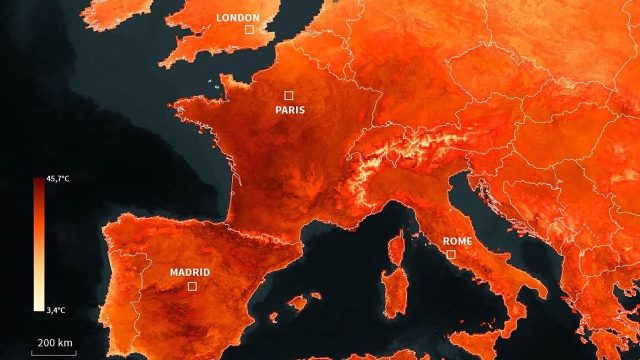
Western Europe is experiencing a heatwave that has resulted in over 50 deaths in France alone. These unprecedented high temperatures, which can impact human health and a number of industries, are due to a weather phenomenon known as an omega block.
What is an omega block?
An omega block is reminiscent of the shape of the Greek letter Ω, with a “bulge of warmer, settled high pressure held between two cooler low-pressure systems,” said Reuters. The high-pressure warmth is essentially “blocked” by the low-pressure systems surrounding it. As a result, “hot, still air gets lodged over the same area,” and “conditions become hot and dry.” The high pressure also “suppresses cloud formation, resulting in clear, sunny skies that allow temperatures to climb.” Omega blocks usually last between three and ten days, but can go on for longer.
With the current omega block, a “surge of hot, dry air from North Africa has become trapped in the atmosphere over parts of Europe,” said Time. France “recorded its hottest day since records began nearly 80 years ago, when temperatures peaked” at 111.74 Fahrenheit in the “southwestern town of Pissos,” said CBC. In Paris this week, temperatures hit a June record of 105.62 F.
The U.K., Spain, Germany, Italy and several other countries are also experiencing temperatures much hotter than normal. Across most of Western Europe, “June is warming faster than any other month,” said an analysis by World Weather Attribution (WWA). “Extreme heat is already reaching the limits of our societies’ ability to cope.”
How will heat affect the future?
Scientists have “not yet agreed upon how climate change is affecting the frequency of blocking events,” said Reuters. But the “consensus is clear that climate change is increasing the frequency and intensity of heatwaves.”
Climate change is responsible for driving up temperatures all over the world, but “particularly in Europe,” said the BBC. Europe is the “fastest warming continent, heating up twice as fast as the global average.” The current heatwave is also the “most severe and widespread” to have “ever affected this large a region” on the continent, Theodore Keeping, an extreme weather research associate at Imperial College London who worked on the WWA analysis, said to The Guardian.
Extreme heat, especially when mixed with high humidity, poses “risks for public health and infrastructure, as well as transport, energy and water supply,” said Time. Many industries, including tourism, have also been affected. During the recent heatwave, the “Eiffel Tower and the Louvre announced early closing times, and the Changing of the Guard outside Buckingham Palace was scaled back, without the usual ceremony of soldiers in scarlet tunics and heavy bearskin hats,” said CBC.
When it comes to health, everyone can be affected by heat, but certain groups are more at risk for heat-related illness, including babies, children and older adults. “Heat exposure and dehydration during pregnancy have also been linked to complications including premature birth, low birthweight and an increased risk of stillbirth,” said Time. Experts recommend remaining inside with the curtains closed during the hottest parts of the day and staying hydrated.
The phenomenon traps hot air over a region