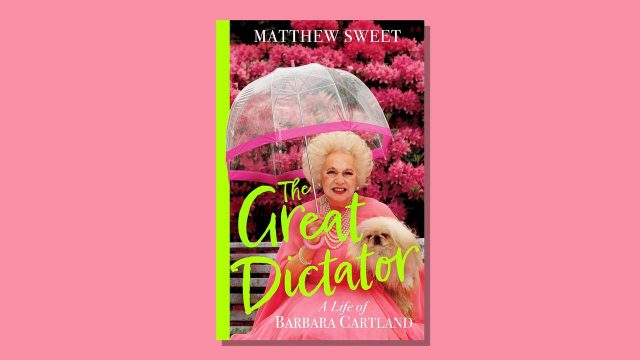
Barbara Cartland, like most successful writers, was a creature of routine. Every day, between 1.15pm and 4pm, she would recline on a chaise longue, “clad in brilliant pink, hair a platinum helmet”, and dictate around 7,000 words to a secretary while “fondling a Pekingese”, said Wendy Holden in Literary Review.
By these means, she churned out roughly 20 novels a year – more than 700 over the course of her lifetime – and sold 750 million copies, a figure “exceeded only by Shakespeare and Agatha Christie”.
While her “tales of virgins and sheikhs, pirates and princesses” were devoured across the world, they proved especially durable in the Middle East: “Arab men,” she noted, “can’t get enough of the sort of girl I write about.”
It would be easy simply to mock Cartland, but the journalist and broadcaster Matthew Sweet avoids this trap in “The Great Dictator”. Without skipping over her faults, he “gives her virtues full credit” and treats her as a figure of “cultural and historical importance”. The result is a “fantastically enjoyable, drily hilarious and incredibly well-researched biography”.
Cartland may have had a “marshmallowy exterior”, but Sweet shows in this “brilliant book” that behind it “lurked sinews of high-tensile steel”, said Kathryn Hughes in The Guardian.
Coming of age just after the First World War, at a time when there “were not enough husbands to go around”, she resolved to be “financially self-sufficient”.
She spent the 1920s working as a gossip columnist, reporting on the escapades of the Bright Young Things, before making a “tactical marriage to a dull man called Alexander McCorquodale”, who proved to be an alcoholic. Divorcing him after having a daughter, Raine (the future Countess Spencer, stepmother to Diana, Princess of Wales), she “effected a neat swap” by marrying his paternal cousin, which meant she didn’t even need to change her surname. In 1950, the pair settled in Camfield Place, a manor house in Hertfordshire, where she lived until her death in 2000, aged 98.
“Sweet writes with great wit and brio but also considerable sympathy,” said Lynn Barber in The Observer. He points out that Cartland was a “great organiser”. While clothes were rationed during the Second World War, she set up a scheme to lend wedding dresses to Auxiliary Territorial Service brides. Later, she led a campaign to create a reservation for Gypsies near Camfield Place: “Barbaraville” opened in 1963 and “remains to this day”. It is, Sweet suggests, “perhaps her most lasting achievement”.
Matthew Sweet’s carefully researched book is ‘fantastically enjoyable’