
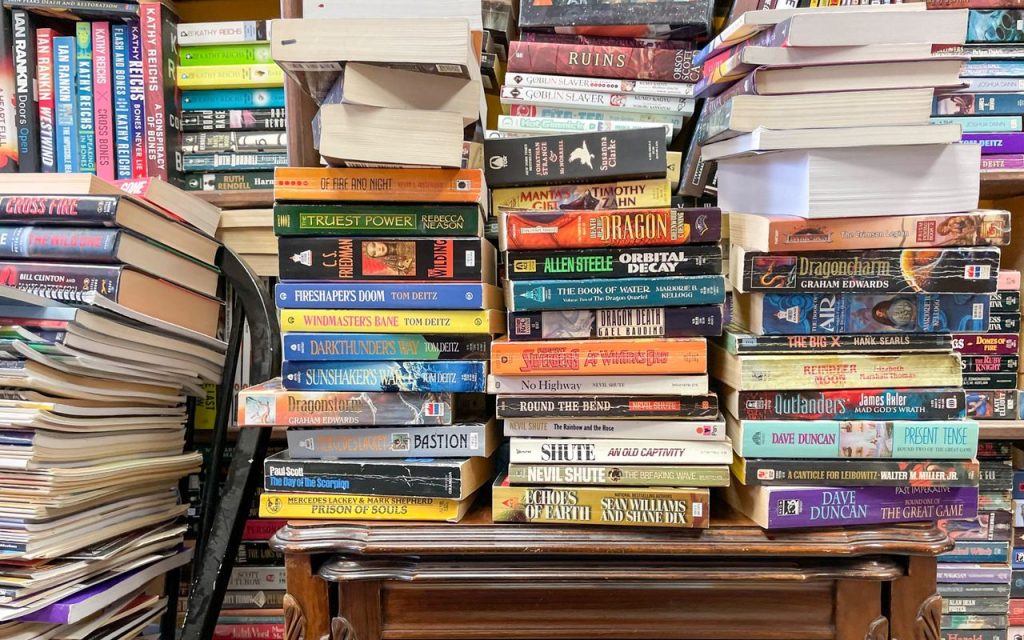
For years, mass-market paperbacks have been credited with making books more accessible and affordable. The wee books could be found in places most people shop, like grocery stores, and were even responsible for the popularity of some authors, including horror icon Stephen King. However, a decline in sales and shifts toward other, more expensive books have led to what may be the end of the pocket-sized format.
Readers ‘leading the move away from mass markets’
After nearly a century in wide circulation, mass-market paperbacks are “shuffling toward extinction,” said The New York Times. Sales have dropped over the years, “peeled away by e-books, digital audiobooks and even more expensive formats like hardcovers and trade paperbacks,” the mass market’s “larger and pricier cousin.”
Last year, ReaderLink, the country’s largest distributor of books to airports, pharmacies and big-box stores, announced that it would no longer carry mass markets. The books can still be found in some places, but “as a format, I would say it’s pretty much over,” Ivan Held, the president of publishing imprints Putnam, Dutton and Berkley, said to the Times.
Since the 1930s, mass-market paperbacks have been “beloved for making reading accessible,” said Smithsonian Magazine. Typically printed on cheaper paper and measuring “roughly four by seven inches,” they were “marketed wherever people shopped, filling racks in grocery aisles, drugstores, gas stations, newsstands and malls.”
Mass market unit sales “plunged from 131 million in 2004 to 21 million in 2024, a drop of about 84%,” according to Circana BookScan, and sales through October 2025 were about 15 million units, said Publishers Weekly.
It wasn’t publishers “leading the move away from mass markets,” said the Times. “It was readers.” Mass markets were not just “cannibalized digitally.” Readers appear “more willing to buy books in larger, pricier formats.” Romance readers “happily shell out three or four times the price of a mass market on deluxe hardcovers with colorfully stained edges on the paper or other embellishments.”
‘One more nail in a coffin’
Industry insiders are mourning what they see as an end to accessible literature. Mass-market paperbacks “democratized America,” Esther Margolis, the publisher of Newmarket Books, said to Publishers Weekly. For the equivalent of a dollar or two, “you could be educated,” she said to NPR. You could “pick them up at the school book fair” or at the local gas station. “You can’t really do that today.”
While Anne Paulson, the store manager and a bookseller at Cherry Street Books in Minnesota, was saddened by the decline of the paperback, she is not surprised. “I knew that it was coming,” Paulson said to Alexandria Echo Press. The shift away from mass markets “may take brand new books out of people’s hands” who could not “otherwise afford a brand new book.” It is “just one more nail in a coffin of removing reading and literacy from our radar.”
The removal of mass-market paperbacks is an “indication of the book affordability crisis,” R. Nassor said at Book Riot. Ultimately, “I can accept mass-market paperbacks as a thing of the past” but not the “existing cheap alternatives as a consolation prize.” A trade paperback that is “50% more expensive — even accounting for inflation” and a “pricey monthly book subscription are not enough to replace a $10 book you could own.” Now is not the time to “roll back affordable options for consumers in any entertainment space.” It doesn’t help that editorial teams are not “seeing dramatic increases in wages as a result of rolling back affordable book formats.”
The diminutive cheap books are phasing out of existence