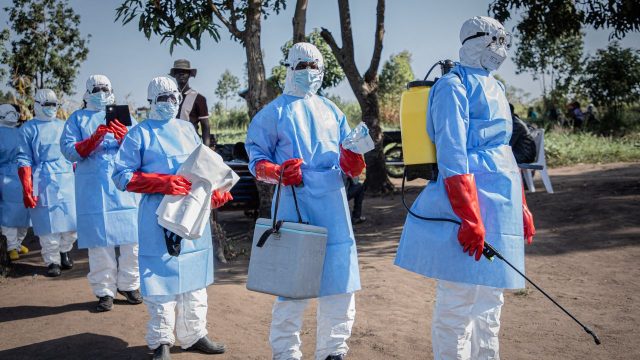
What the US is trying to do in Kenya reeks of “neo-colonialism”, said The Daily Nation (Nairobi). To protect Americans from the deadly Ebola outbreak that is thought to have already killed at least 91 people in the Democratic Republic of Congo (DRC), the Trump administration has decreed that no one with the disease may enter its borders, even if they’re a US citizen. Any American unlucky enough to have contracted the virus in DRC should instead be sent for treatment hundreds of miles away to a specially commissioned Ebola health centre in Kenya.
Cue outrage in Nairobi. “Kenya is NOT America’s biohazard dumping ground,” fumed a spokesman for one of Kenya’s doctors’ unions, echoing widespread fury at the proposal to set up a 50-bed quarantine facility at Kenya’s Laikipia Air Base. And hundreds of protesters took to the streets of Nanyuki, the town closest to the air base, fearing the disease might spread to their community. They blocked roads and set fire to tyres, and police had to fire tear gas to disperse them.
According to some reports, two people were shot dead. Yet despite the uproar, and a temporary court order blocking the site’s construction, Kenya’s President William Ruto has vowed to press ahead with it.
Potentially ‘catastrophic’
The debacle in Kenya is far from the only mistake the US has made over the Ebola crisis, said The East African (Nairobi). “Epidemics are best fought collectively”, but under Trump the US has withdrawn from the World Health Organisation (WHO) and shut down USAID, scuppering the international response needed to stem the current outbreak, which has now spread to Uganda.
Trump’s decisions have been disastrous, said Craig Spencer in The New York Times. Over the past year, critical surveillance networks in DRC have been dismantled, with the result that US officials only learnt of the first Ebola death a month after it happened, making it inevitable that the outbreak would turn “catastrophic” in scale.
To put this in context, the world’s worst-ever Ebola outbreak, which broke out in Guinea in 2014, went on to kill 11,300 and infect 28,600 others. That outbreak was first detected when there were around 40 to 50 cases; for this one, that number was 400 to 500. And to make matters worse, rapid tests and vaccines do not exist for the Bundibugyo strain of Ebola that is behind this latest epidemic.
“We are not getting ahead of this virus. We are running after it,” said Denis Mukwege in Le Monde (Paris). It’s already the third-largest outbreak in history, and could well become the deadliest ever.
Deep mistrust
The challenges facing teams on the ground are immense. For a start, the epicentre of the outbreak is war-torn eastern DRC, where conditions make contact-tracing almost impossible. And as the US has cut aid to the DRC from $1.34 billion in 2024 to just $428 million in 2025, local responders have “far fewer resources” than in any comparable recent crisis.
To add to the crisis, front-line health workers are “deeply” mistrusted by the local population, said The Economist. Look what happened two weeks ago in the small town of Mongbwalu in northern DRC, where a group of young men made four different attacks on the local hospital in a bid to retrieve the body of an Ebola victim for burial. The day before that, townsfolk had torched an isolation unit.
The crucial requirement is for the response to be consolidated under a single actor, just as it was for the 2014 outbreak when the UN Mission for Ebola Emergency Response (UNMEER) took charge, said Anthony Banbury in The Washington Post. Congolese health workers and international NGOs have done an excellent job so far, but the lack of coordination has been a serious hindrance. “It is like going to war with scattered, independent military units, but no central headquarters directing the overall effort.”
In the absence of a body like UNMEER to devise and oversee a strategy for containing the outbreak, this epidemic could “spin out of control”. And then the world would be in real trouble.
US aid cuts and proposed treatment centres in Kenya are stirring anger, while front-line resources are needed urgently to contain the crisis