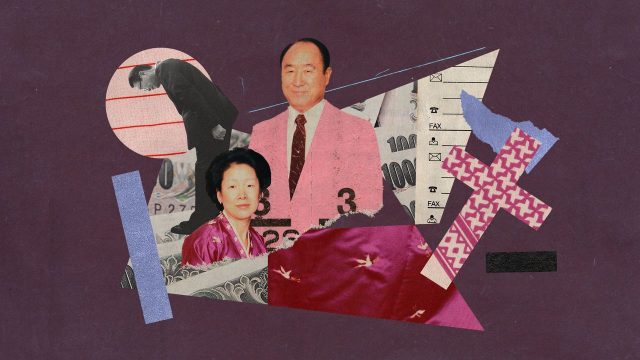
The Tokyo High Court has upheld a decision to dissolve the Unification Church, a controversial religious organisation linked with the assassination of former Japanese prime minister Shinzo Abe. Tetsuya Yamagami, the convicted murderer who was sentenced to life in prison, cited Abe’s affiliation to the church as his primary motivation for the killing.
The church used “coercive tactics to solicit large donations” from its members, said The Japan Times. A lower court ruled last year it had “committed acts in violation of laws and regulations”, which were “significantly harming the public welfare”.
Forced compensation
There has been “intense societal focus on the rulings” due to the “scope of harm” the organisation has caused across the country. Under the Religious Corporations Act, the church will be forced to compensate those affected – around 1,500 people – with “damage fees totalling approximately ¥20.4 billion” (£97 million).
The church will also lose its title as a religious organisation, so it can continue only as a “voluntary organisation” and as such will lose tax benefits. Even if the church appeals the decision to the Supreme Court, the liquidation process can proceed immediately.
The Unification Church is a South Korean movement that has “exerted significant influence in Japan since the 1960s”, said The New Yorker. It was founded by Sun Myung Moon and followers are referred to as Moonies. They promote a “theological mix of Christian Messianism, Cold War anti-Communism, pro-natalism, and self-adulation”. Around the same time, Moon “befriended” Shinzo Abe’s grandfather, Nobusuke Kishi, “a war criminal who later served as prime minister” and head of the Liberal Democrats, Abe’s future party.
The church “boasted of having millions of members around the world”, ranging from “Brazil to Nigeria”; however, “this number was likely inflated”. By the 1990s, there were about 600,000 Unificationists in Japan, “twice as many as in Korea”, and today the organisation still has around 60,000 followers in Japan. As recently as 2017, the church’s annual fundraising goal in Japan was an “astounding” $200 million, according to a former official, though the church denies this.
‘Exploiting fears’
It was the “shock assassination” of Abe in 2022 that put the Unification Church under global scrutiny, said the BBC. Yamagami, who has appealed his sentence, “had held a grudge against the prime minister” because of his closeness to the organisation, “which had bankrupted his family”.
Investigators found that the church “coerced” followers into “buying expensive items” by “exploiting fears about their spiritual well-being”, and also revealed “close ties with many conservative lawmakers”.
Abe had appeared in a 2021 video expressing his “respect” for the church’s leader and wife of Moon, Han Hak-ja, said Nippon.com. The following year Abe was killed by Yamagami, who harboured a “deep-seated resentment” of the religious organisation, stemming from the “financial duress his family suffered” at its hands.
The “political connections” the church had “are just the tip of the iceberg” as many other issues “remain unresolved three and a half years after” Abe’s murder. “So much suffering could have been avoided had those in power in both Japan and South Korea not waited to act against the UC.”
To combat the “universal threat” of “cults” like the Unification Church, Japan should “draw on foreign legal frameworks like France’s anti-cult laws”. This is an “ongoing human rights crisis that can no longer be ignored”.
The church, whose links to former prime minister Shinzo Abe were at the heart of his assassination, will be forced to return ‘coercive’ donations