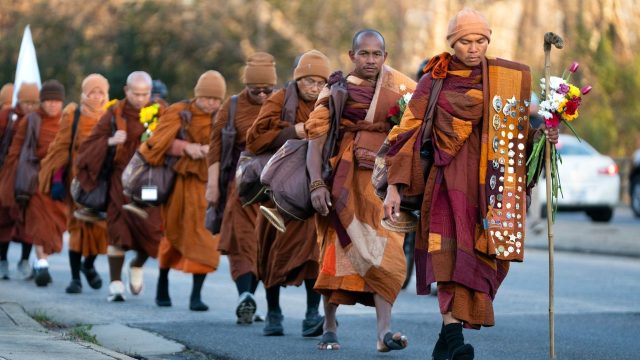
After more than 100 days on the road, a party of Buddhist monks have arrived in Washington, completing their 2,300-mile “walk for peace” across the United States.
The group, which set off from a temple near Fort Worth, Texas in late October, numbered around two dozen and included monks from Thailand, Vietnam, France, Burma and Sri Lanka. They have amassed more than five million followers across Facebook, Instagram and TikTok over the course of their journey, said Rolling Stone.
The monks plan to use their visit to the capital to petition for Vesak – the Buddha’s birthday – to be recognised as a national holiday, said the BBC. But they said on Dhammacetiya, their official website, that they were not marching with a political agenda or to “force peace upon the world, but to help nurture it, one awakened heart at a time”.
‘Hope and encouragement’
The journey has “not been easy”, said The New York Times. The southern states have experienced an “unusually harsh” winter. Faced with snow and ice, the walkers wore scarves and coats over their orange robes and those walking barefoot were forced to temporarily don boots. To make matters worse, before the group had even left Texas, a truck driver accidentally crashed into one of the support vehicles, which in turn struck two of the monks, one of whom was so severely injured he required a leg amputation.
Along the way, the monks ate and slept at temples, churches, universities and community centres, bedding down in sleeping bags on the floor or outdoors in tents. Two members of the group practised “dhutanga”, said The Guardian, a Buddhist form of asceticism in which devotees never lie down, even to sleep. Instead, they “sit down in a meditation position, and they meditate all night” to “replenish their energy”.
At every stage, crowds have “swarmed” around the monks, said The New York Times. These supporters have “transcended racial, religious, economic, educational and geographic lines”, sharing a common belief that the monks were providing “comfort”, “hope and encouragement” that “otherwise seemed to be in short supply” in a politically polarised nation.
Thousands of well-wishers followed the journey remotely via online trackers, while the monks’ dog, Aloka, whose name means “light” in Sanskrit, has “become a celebrity in his own right”, recognisable for the “heart-shaped mark on his forehead”.
End of the road
While “millions are finding hope in their journey”, said Rolling Stone, there has been “pushback” at multiple stages during the walk. Around “a dozen Christian protesters” have trailed the walkers, bearing signs reading “Jesus Saves” in opposition to what they see as “a religious movement, promoting Buddhism”.
And “although the monks’ walk is not a direct commentary on politics, it coincides with a sense of unease spreading across the country”, which has also generated some political resistance. In Georgia and South Carolina, protesters carried placards and megaphones, with some signs “resembling Maga flags”.
But the predominant response has been one of welcome, support and encouragement. “My hope is, when this walk ends, the people we met will continue practising mindfulness and find peace,” said the group’s leader, the Venerable Bhikkhu Pannakara.
Tuesday marked the final day of walking, taking the total number of days to 108, “a sacred number in Buddhism, Hinduism and Jainism”, said NPR. “It represents spiritual completion, cosmic order and the wholeness of existence.”
This won’t quite be the end of their journey, however. After a visit to the state capitol building in Annapolis, Maryland, the monks will take a bus back to Fort Worth, and then “will walk together again”, although this time only for six miles, to return to “the temple where their trip began”.
Crowds have turned out on the roads from California to Washington and ‘millions are finding hope in their journey’