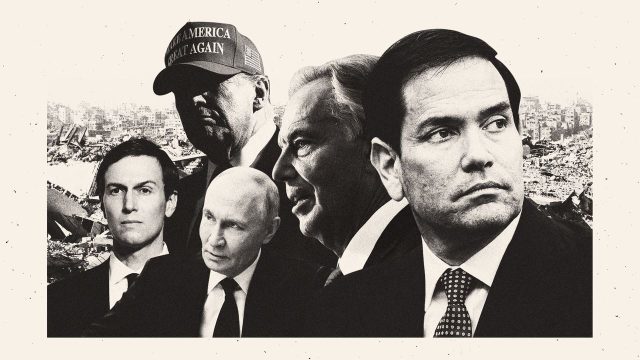
Vladimir Putin could sit alongside Tony Blair, Marco Rubio and Jared Kushner on Donald Trump’s Board of Peace. The Kremlin confirmed the Russian president had been invited to join the new body, which was formally launched last week and will be chaired by Trump himself.
Originally part of the US-brokered 20-point peace plan to end the war in Gaza, the Board of Peace will oversee the territory’s reconstruction, but recent developments suggest ambitions for the organisation go well beyond Gaza.
Who is on it?
With his characteristic effusiveness, the US president posted on Truth Social that the committee he has assembled was the “Greatest and Most Prestigious Board ever assembled at any time, any place”.
The founding executive board, headed by Trump himself, includes former UK prime minister Tony Blair, US Secretary of State Marco Rubio, US special envoy Steve Witkoff, World Bank president Ajay Banga, and Trump’s son-in-law and close adviser, Jared Kushner.
The “exact structure” of the board “remains unclear and members are still being invited”, said the BBC. Invitations have also been sent to the leaders of “Argentina, Paraguay, Turkey, Egypt, Canada and Thailand”, said The Guardian. The White House and the Kremlin have both confirmed that an invitation has been extended to the Russian president, a gesture that lends “considerable weight to long-standing suspicions that Trump leans heavily in Putin’s favour in his approach to the Ukraine conflict”.
As chair, Trump will decide who is invited to join, giving him an effective veto. Member states will be limited to three-year terms on the Board of Peace, but those that contribute more than $1 billion in the first year can become permanent members, said Bloomberg.
How will it work in Gaza?
The Bulgarian former UN Middle East envoy Nickolay Mladenov will serve as the executive board’s high representative for Gaza. A 15-member Palestinian technocratic committee, the National Committee for the Administration of Gaza (NCAG), has also been set up, tasked with running day-to-day affairs on the ground in the devastated enclave. Major General Jasper Jeffers, the former head of US special forces, has been appointed to lead an International Stabilization Force (ISF), a multinational peacekeeping unit that will be responsible for security across the territory.
Yet another committee, the Gaza Executive Board, will work with Mladenov, the NCAG and the ISF. The board is “designed to provide regional and international coordination”, said Middle East Eye, although it is “unclear what responsibilities the board or its members would have”.
What else could it do?
According to a draft of its charter, the board will seek to “solidify peace in the Middle East” and, at the same time, “embark on a bold new approach to resolving global conflict”, said The Guardian.
Notably, there is no mention of Gaza in the charter itself, adding to “speculation that the group may have a broader mandate to cover other conflicts and could even be aimed at creating a US-dominated alternative to the United Nations Security Council”, said The New York Times.
US officials had already “floated the idea of allowing the board to mediate in other hotspots such as Ukraine and Venezuela”, said the Financial Times, and the wording of the charter “appears to give credence to diplomats’ fears that the Trump administration is seeking ways to sideline the UN”.
“It’s just very confused as an idea,” said a senior European official. “What does ‘membership’ mean? Is it an alliance or a body for mediation between adversaries?”
Body set up to oversee reconstruction of Gaza could have broader mandate to mediate other conflicts and create a ‘US-dominated alternative to the UN’