“Those who saw the video will not easily forget it,” said Rory Carroll in The Guardian. It showed an assailant sat astride his victim on a street in north Belfast, stabbing him in the face and neck, while shouting in Arabic.
Passers-by intervened to help Stephen Ogilvie, who was badly hurt during the attack last Monday; he lost an eye and suffered other injuries. And “the judicial system was fast”: less than two days later, Hadi Alodid, 30, a Sudanese refugee, was charged with attempted murder.
But long before that, said George Odling in The Times, the footage had spread around the world. Tommy Robinson, who was in Moscow, shared it with his two million followers on X/Twitter barely an hour after the attack, saying it showed an “invader trying to behead a man”. Elon Musk called on people to protest. Anti-immigrant activists in Northern Ireland were quick to latch on, posting meeting points for mass protests, and disseminating “hit lists” of migrants’ homes and hostels.
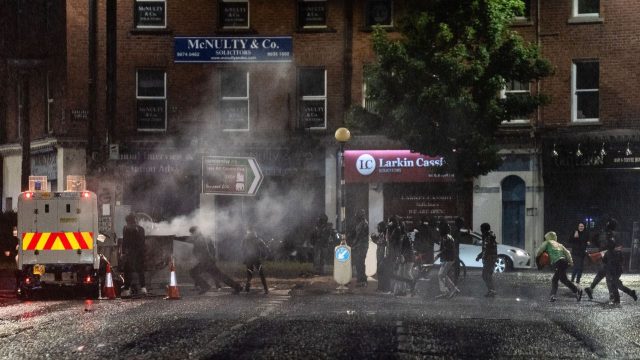
Before nightfall the following day, protesters had closed arterial routes around Belfast, said The Economist. Petrol bombs were then thrown at police; a bus and police vehicles were set on fire; 12 officers were injured. But foreigners were the real targets. Doors were kicked in, cars and homes torched. Ugandan care workers, Indian IT professionals and a Middle Eastern supermarket were attacked, said Sky News. A family with a young child had to be evacuated in an armoured police car as their home went up in flames. In Glengormley, a mob targeted a hotel that housed asylum seekers.
‘Migration back door’
The violence was “disgusting”, said The Times, but the “clichéd condemnation” that followed failed to acknowledge the root cause: immigration. “The general perception is that legal and illegal immigration is out of control, that Britain is a soft touch”, and that millions are being spent on refugees who can pose a real danger to UK citizens. The issue now poses an “explosive” threat to “national stability”.
This case also exposes another huge hole in our borders, said David Frost in The Daily Telegraph. Alodid had travelled to Northern Ireland via Paris and Dublin. It’s unclear how he was able to fly to the Republic, without a visa; but once there, because of the Common Travel Area, he was able to enter Northern Ireland without passing through immigration controls. When anyone from any country who can get into Ireland can get into the UK, “we have a migration back door”.
It is “asinine” to accept the far-right claim that these riots were an expression of serious concerns about immigration, said Séamas O’Reilly in The New Statesman. An alleged crime by a single Sudanese man in no way explains or justifies rioters “carrying out a pogrom against every migrant or non-white person” they can find. We would never see attacks on white British people as a legitimate response to murders committed by white Britons. For those of us who always find such justifications dubious, it’s revealing to see them deployed in Northern Ireland, “where immigration barely exists”. Only 3% of its population belong to an ethnic minority. Net international migration, from 2001 to 2023, reached just 62,000 people in a country of two million; there are currently about 2,400 refugees.
Disturbing new politics
In fact, the “chilling thing” is how familiar last week’s riots felt, said Michael Magee in The Independent. “I wish I could say that this is not the Belfast I grew up in, but loyalist mobs rampaging through the city is nothing new to us.” Most, if not all, of the rioting took place in unionist areas; instead of contested parade routes or flag disputes, the “orchestrated violence” was directed at a new enemy: immigrants and asylum seekers.
The awful thing is that “immigration riots work”, said Max Jeffery in The Spectator. The Roma whose homes were burned in Ballymena in County Antrim last year have not returned. The asylum seekers and immigrants attacked last week will likely move away.
We are seeing a disturbing new politics in Britain, said Jason Okundaye in The Guardian, stoked by the smartphone and social media. The public is now consistently fed a stream of shocking, graphic images – such as the footage of a dying Henry Nowak, or of Stephen Ogilvie being attacked – which previously would have been seen only by investigators or in a courtroom. Politicians of the hard-right exploit these to foment rage and disorder, pushing a narrative of a UK invaded by third-world criminals.
Yet it would be wrong to blame everything on social media, said Janice Turner in The Times. It’s hard to ignore the many “vicious, unprovoked” crimes committed by refugees, particularly those fleeing extreme violence – in, for instance, Sudan or Afghanistan. Jonathan Hall, the independent reviewer of terrorism legislation, noted last week that refugee rights can conflict with “national security”. Britain needs to grasp this issue, “or get used to riots”.
Disorder over migrant knife attack shines a light on new era of political violence fuelled by social media