
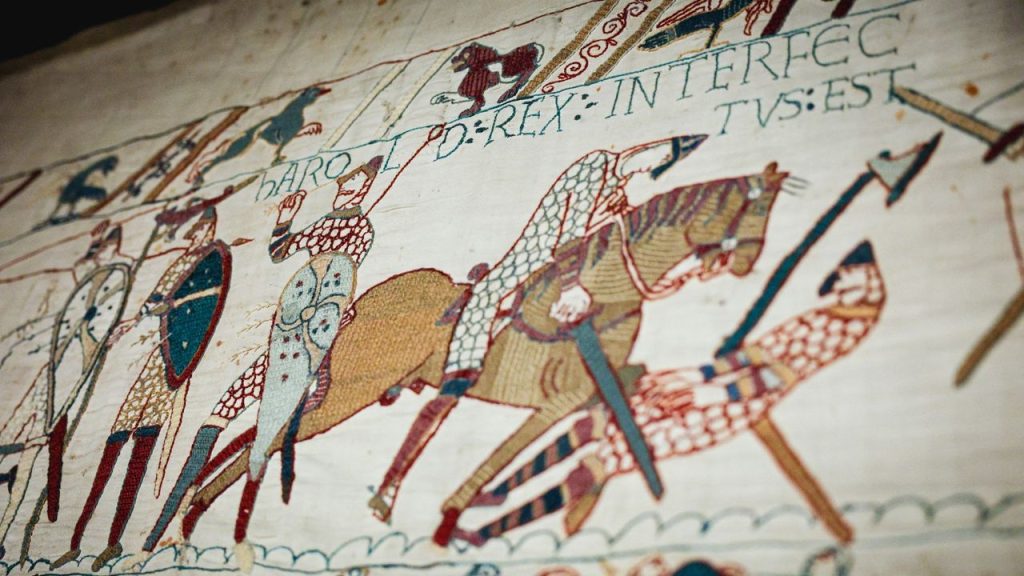
The Bayeux Tapestry, which opens today at the British Museum, is “shivers-down-the-spine, tell-the-grandchildren sort of stuff”, said Laura Freeman in The Times. Textbooks can tell you the facts: “seventy metres, 58 scenes, 626 figures”, but the reconstructions and photographs are nothing like the real thing. In fact, it’s “more than a shiver of excitement”, it’s the “loan of the millennium” and truly “magnificent”.
The British Museum is offering a “once-in-a-lifetime – no, once-in-history – opportunity to experience a genuine wonder of the world at close quarters”, said Mark Hudson in The Independent. Right from the off, it is best to “let the images carry you”. After Harold assumes the throne, having sworn allegiance to William on a trip to France, the early sections of the Normans’ preparations for war have a “documentary veracity” and “cinematic drive, that propels us remorselessly onwards to the departure of the Norman longships towards the English shore”.
Throughout, the Tapestry portrays “storytelling of the highest order”, and “simply getting it to London is a momentous achievement”, said Alastair Sooke in The Telegraph. Its “most famous section”, the Battle of Hastings, feels like an “11th-century equivalent of Pablo Picasso’s anti-war masterpiece ‘Guernica’ (1937)”. It is “pure carnage”. Horses fall, warriors are decapitated and a mace flies through the air: “an emblem of anarchy and violence”. But far from a “tub-thumping celebration of Norman power”, it is striking how much it feels like a “requiem” for Anglo-Saxon England. “To see this astonishing artefact back in Britain for the first time in 1,000 years is the most moving moment of my career.”
The pace of the battle scenes “hurtles along”, said Jonathan Jones in The Guardian. But in the borders, the Tapestry sets out its action in a “wider world, and even, when it shows the comet, a larger cosmos”. Against the brutality of the violence, depictions of peasants working the land are stitched in “distracting, vibrant detail”. This is both “pointed and poignant: whoever wins, whoever rules England, country people will still work the soil”.
Some of the best bits are when there is no violence at all, said Jo Lawson-Tancred on Artnet. The artwork certainly has some historical “limitations” of accuracy, but most importantly it offers a “rare, secular insight into a medieval way of life that might otherwise feel too remote to imagine”. We see unique depictions of a “lavish” Norman feast of food seized from the English in Pevensey, with striking detail of cooking in a “cauldron over fire and serving roast meat on skewers”.
There are moments of levity, too, said Andrzej Lukowski in Time Out. It may be “extravagantly otherworldly”, but it is also “accessible by dint of its simplicity”. The narrow tapestry is “topped and tailed by joyously random images of fantastical beasts and the odd weird naked guy”. This is not just an artefact consigned to the past: “it’s boyishly excitable about the details of conflict, an action comic realised in millennium-old cloth”.
The Bayeux Tapestry is on display in the British Museum from 10 September 2026 until 11 July 2027. Tickets will next be released on 21 October for viewings between 1 January and 31 March 2027.
Exhibition at the British Museum promises a ‘once-in-history’ viewing experience