
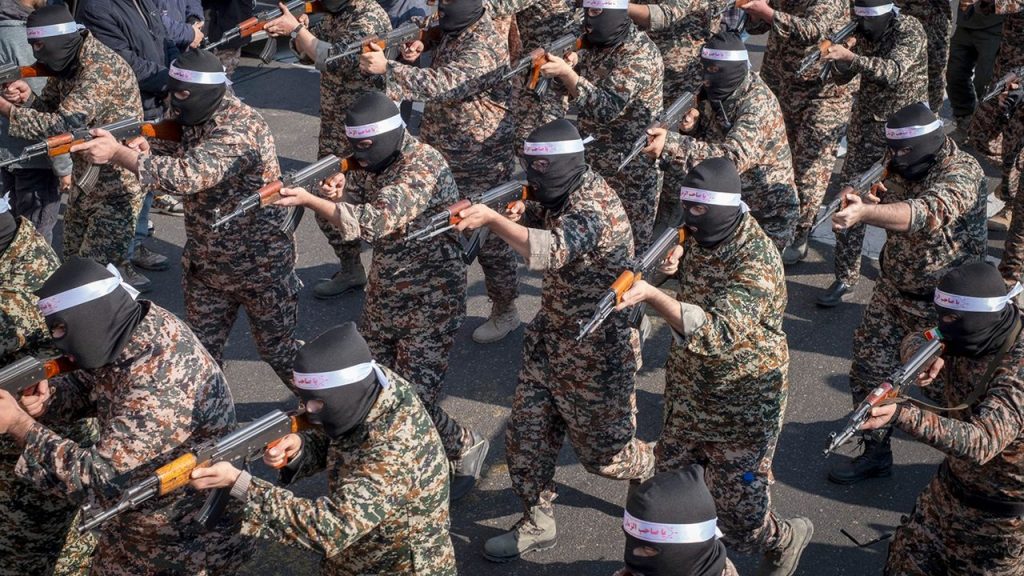
What is the IRGC?
Officially, the Islamic Revolutionary Guard Corps is the military force sworn to protect Iran’s ruling clerics. Yet its enormous reach, into all aspects of political and economic life, makes it a state within a state. Far better resourced than Iran’s regular armed forces, the IRGC controls roughly half of the country’s $376 billion economy and directs Iran’s nuclear program. It has responded to international sanctions with a “resistance economy” of illicit activities, including smuggling arms, narcotics, and alcohol. Abroad, its network of violent proxy groups in Iraq, Lebanon, Syria, Yemen, and Gaza has destabilized the Middle East for decades. And the current war has only further tightened its stranglehold on Iranian society. When President Trump early on threatened the IRGC with “certain death” if it did not immediately surrender, it responded by mining the Strait of Hormuz and greenlighting attacks on Gulf Arab states. “The survival of the Islamic Republic is dependent on the IRGC,” said Georgetown University political scientist Nader Hashemi. “They were created for a moment like this.”
How was the IRGC created?
After the 1979 Islamic Revolution, Ayatollah Ruhollah Khomeini didn’t trust Iran’s conventional army, saying it had “the Shah in its blood.” He set up the IRGC as his own parallel force, and during the Iran-Iraq war in the 1980s it absorbed the myriad local armed groups that had sprung up around mosques. When Ayatollah Ali Khamenei became Supreme Leader in 1989, he allowed the IRGC to take over the economy, controlling weapons procurement, construction, and government contracts. Now it has some 200,000 active members and holds monopolies over critical infrastructure and major industries. “It’s like a huge investment company with a complex of business empires and trading companies, while also being a de facto foreign ministry,” said Mohsen Sazegara, who helped found the IRGC and is now an exiled Iranian dissident. “I know of no other institution like the Revolutionary Guards.” An attractive employer for men in need of steady income, it has an intense indoctrination program stressing the imperative of jihad against Jews and other infidels. It exports these ideals through its elite branch, the Quds Force.
What is the Quds Force?
It’s the armed IRGC wing charged with spreading “revolutionary values” abroad and training proxy militias. In the early 1980s, a Quds group in Lebanon helped create Hezbollah and masterminded the bombings of the U.S. Embassy and the U.S.-French barracks in Beirut, which together killed 370 people, 258 of them Americans. And it trained Shiite militias in Iraq to plant roadside bombs that killed hundreds of U.S. soldiers. But its primary archenemy is Israel and Jews, who are frequently targeted by its proxies. In 1994, a bomb killed 85 people at a Jewish community center in Buenos Aires, an attack said to have been planned by the IRGC’s current commander, Gen. Ahmad Vahidi. The force trained Hamas in Gaza ahead of the Oct. 7, 2023, massacre of Israelis. And IRGC-plotted arson attacks hit Jewish institutions in Australia in 2024.
Are there other wings?
The Basij, a paramilitary security force, has around 600,000 reservists at its disposal to quash dissent. Black-clad brigades typically disperse protests with batons, tear gas, and guns; their crackdown on last winter’s protests killed up to 40,000 civilians. “The population of Iran may wish what it will,” said former U.S. army adviser Brad Patty, “but they are meant to live in terror of the IRGC.” The Revolutionary Guards also have an intelligence service as well as their own versions of traditional military service branches. That includes ground troops, a 15,000-member air force that runs Iran’s missile program, and a navy of some 20,000 that patrols the Strait of Hormuz. All these branches, plus the IRGC’s drone center and cybercommand, are directing Iran’s response to the U.S.-Israeli attacks.
How are they doing?
Better than anticipated. U.S. and Israeli air strikes have hit well over 15,000 Iranian targets, destroying ballistic missile sites as well as killing Supreme Leader Ali Khamenei, IRGC commander Mohammad Pakpour, security chief Ali Larijani, and several other senior officials. But Iran, which watched the 2003 toppling of Saddam Hussein next door, has been hardening its regime ever since. The IRGC has built layers into its dispersed chains of command and trained its troops in asymmetric warfare. Though Trump boasted that U.S. strikes have “demolished” Iran’s regular navy and air force, the IRGC versions of those forces have struck more than 20 commercial vessels, sometimes swarming them with lightly armed speedboats. These strategies, Iranian Foreign Minister Seyed Abbas Araghchi recently claimed, mean that “bombings in our capital have no impact on our ability to conduct war.”
What might weaken the IRGC’s grip?
Decapitation strikes won’t do it—the Guards have a bench of replacements handy for each senior post, and their forces are fighting to protect the system, not any individual. Still, some IRGC units are reporting shortages of food, ammunition, and basic supplies, and the decentralization of their control raises the risk that one or more might eventually defect. Defeating the IRGC would “require not a swift campaign but, at best, a prolonged and costly war of attrition,” said Oxford political scientist Ashkan Hashemipour, but “this may prove difficult for the American president to sustain politically.”
Iran’s Islamic Revolutionary Guard Corps keeps order, runs the economy, and exports terrorism