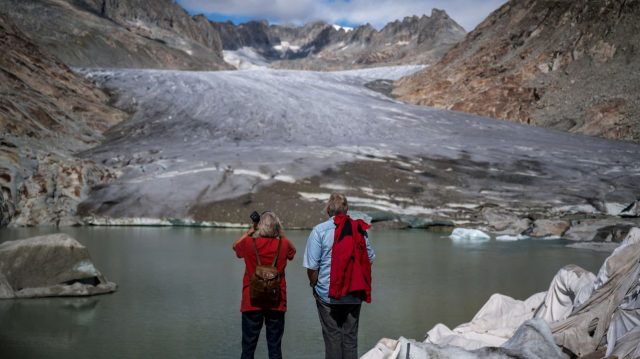
The world’s supply of glacial ice is quickly approaching an alarming milestone, as the planet continues heating to disruptive new heights. In a striking study published this week in Nature Climate Change, researchers modeling multiple warming scenarios predict that the number of glaciers that disappear annually is set to dramatically increase in the coming decades.
The paper introduces the concept of “peak glacier extinction,” defined by researchers as the “year in which the largest number of glaciers is projected to disappear between now and the end of the century.” Peak glacier extinction is the point when anywhere from 2,000 to 4,000 glaciers will disappear annually. With the Alps leading our planet’s glacial disappearing act, the next few years may be a turning point for much of Earth’s ice.
‘We will lose a lot of glaciers’
Although typical glacier studies focus on “mass and area loss,” the newly published research focuses on disappearances of “individual glaciers” — a trend that “directly threatens culturally, spiritually and touristically significant landscapes,” the study’s authors said. The number of individual glaciers is a “less clearly defined metric” that can be “influenced by observational limitations,” but tracking individual disappearances is “important from touristic, cultural and spiritual perspectives.”
The study’s authors used data on 200,000 glaciers obtained from a “database of outlines derived from satellite images” and applied “three global glacier models” to test the ranges under “different heating scenarios,” The Guardian said. Areas featuring the “smallest and fastest-melting glaciers” are “most vulnerable,” unsurprisingly, with about 3,200 glaciers in central Europe set to shrink by 87% by the coming century “even if global temperature rise is limited to 1.5 degrees Celsius.”
Regions with “larger glaciers,” such as Greenland and around the South Pole, would likely experience peak glacier disappearance “later in the century,” ABC News said. “The biggest findings,” the lead researcher and ETH Zurich glaciologist Lander Van Tricht said to the network, “are that we will lose a lot of glaciers.”
‘Point of no return’ for global glaciers
Whether or not we will be “witnessing the deaths of 2,000 or 4,000 glaciers” annually depends on “how much is done to rein in global heating,” CNN said. A mere 20% of global glaciers are expected to exist in 2100 “under 2.7 degrees Celsius of warming, compared to around 50% at 1.5 degrees.” At 4 degrees the world can expect a “nearly complete loss.”
The newly published study shows we are at a “point of no return,” said Eric Rignot, a professor of Earth system science at the University of California at Irvine, to CNN. “Reforming a glacier would take decades if not centuries.” The researchers behind the study hope their paper, along with an accompanying database showing the “projected survival rate of each of the world’s 211,000 glaciers,” will help “assess climate impacts on local economies and ecosystems,” Politico said. Even for smaller, remote glaciers that may not affect water-levels or resources, a disappearance could “have a huge importance for tourism, for example,” Van Tricht said to Politico. “Every individual glacier can matter.”
Central Europe is losing ice faster than anywhere else on Earth. Global warming puts this already bad situation at risk of becoming even worse.