
The full title of this article by Panashe Chigumadzi (The Guardian) is “The Africa exception: the slavery reparations debate was once ‘unthinkable’. Now it is unavoidable.”
As Peter Jordens argues (and we agree), this item is relevant to the struggle for reparations in the Caribbean. The article mentions France’s Taubira Law (in reference to a law proposed and defended by French Guiana deputy Christiane Taubira, which formally recognizes the transatlantic slave trades and slavery as crimes against humanity). It also discusses Sylvia Wynter, Haitian historian Michel-Rolph Trouillot, former Haitian president Jean-Bertrand Aristide and his demand for $21bn restitution from France, and CARICOM and CELAC as sources of leverage. Indeed, Chigumadzi introduces the topic with a discussion of Haiti, quoting Trouillot, who “famously argued that the 1804 Haitian revolution was the ultimate ‘unthinkable’ event – a claim to Black sovereignty that the west could neither comprehend nor countenance.” See excerpts below and read the full article at The Guardian.
Last month, at commemorations marking the 25th anniversary of France’s Taubira law recognising the trafficking of enslaved Africans as a crime against humanity, Emmanuel Macron did the unthinkable: he became the first French president to publicly utter the word “reparations”.
Since 1825, when France punished Haiti for daring to declare itself the western world’s first Black sovereign republic by extorting 150m francs in compensation for the loss of what it regarded as enslaved “property”, reparations to Black peoples and nations have been politically “unthinkable”. [. . .]
Compelled by shifting geopolitical realities and Africa’s growing demands for economic sovereignty, Macron invoked “reparations” 10 times as part of a pre-emptive attempt to shape the terms of engagement before the African Union (AU) adopts its common position on reparations and Ghana hosts a global reparations conference this month. [. . .]
What Macron did not address was what reparations would actually entail: what France would pay, to whom and by when. Above all, he avoided the question of whether France would return the indemnity imposed on Haiti in 1825. [. . .]
Drawing on the AU Framework, Ghana’s resolution sets the record straight: the birthdate of modern sovereignty, and the modern racial capitalist system, is not 1648. It is on the coast of present-day Mauritania in 1441, when the Portuguese sailor Antão Gonçalves captured 12 Africans as the first cargo of the trafficking era.
It is in the Vatican’s papal bulls – Dum Diversas (1452), Romanus Pontifex (1455), Inter Caetera (1493)– which reduced Africans to “perpetual slavery” and codified the Doctrine of Discovery that licensed European conquest. It is, as Sylvia Wynter and Mahmood Mamdani remind us, in 1492, when Columbus “discovered” the “New World” and Spain expelled Jews and Muslims from Iberia. It is in the international law that codified African people as property through the Portuguese Peça de Índias (1513), the Spanish Asiento de Negros (1518), the Dutch West India Company charter (1621), the English Barbados Slave Code (1661), and the French Code Noir (1685). [. . .]

Ultimately, the Africa exception demonstrates that reparations are not simply a moral imperative but a geopolitical question of sovereignty. It is no coincidence that France announces reparations without payment – invoking the language of justice while avoiding its cost – just as growing African demands for sovereignty threaten its economic interests. We cannot wait for the west to deem us sovereign.
The central challenge for the 21st-century global Black reparations movement is to build geopolitical leverage across the African continent, the African diaspora and the global south majority that backed the resolution. One substantial source of leverage is that Africa holds 30% of the world’s known critical minerals – including cobalt, lithium manganese and rare earths – on which the west’s green transition and AI infrastructure depend. Without reparations, there should be no access to Africa’s critical mineral supply chains. [. . .]
For full article, go to https://www.theguardian.com/news/2026/jun/06/africa-exception-slavery-reparations-african-union-justice
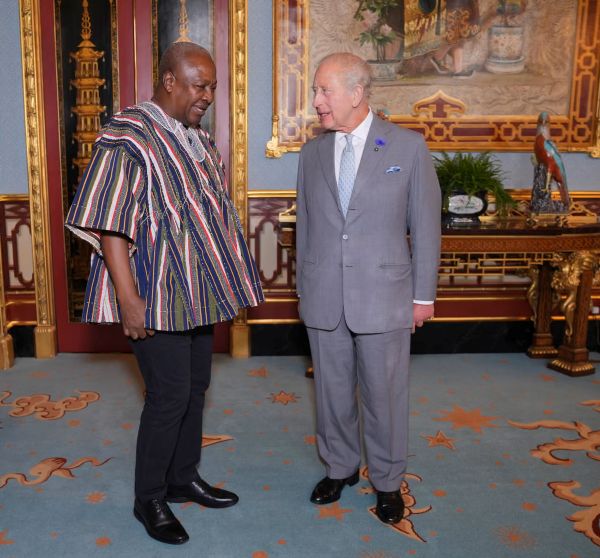
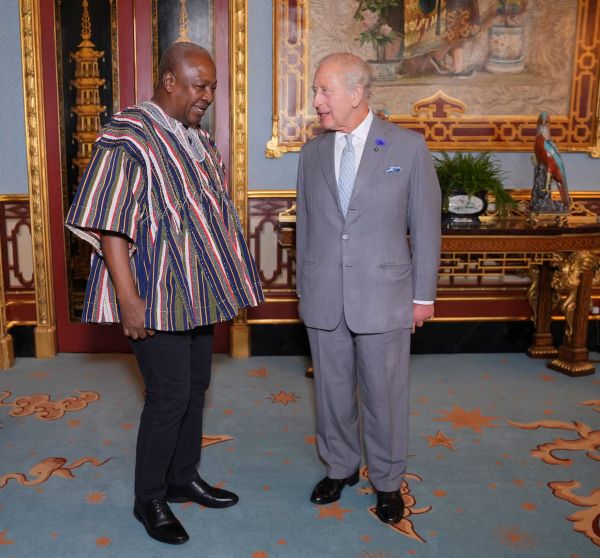
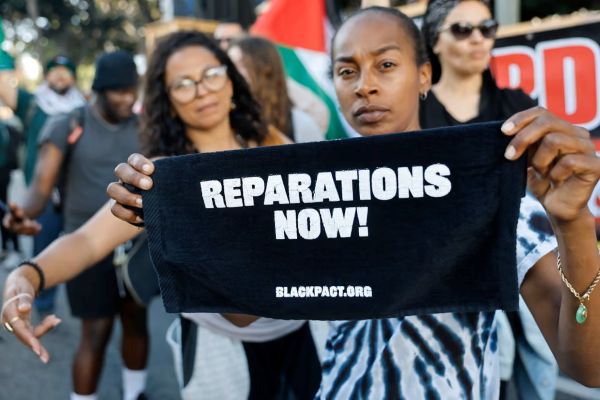
[Photos above: 1) photo by Yui Mok/PA/AP: John Dramani Mahama, Ghana’s president and the AU’s leading advocate for reparations, with King Charles during their meeting at Buckingham Palace, London, on 3 June 2026; 2) photo by Mario Tama/Getty Images: Protesters call for justice at a rally in Los Angeles in 2025.]
The full title of this article by Panashe Chigumadzi (The Guardian) is “The Africa exception: the slavery reparations debate was once ‘unthinkable’. Now it is unavoidable.” As Peter Jordens argues (and we agree), this item is relevant to the struggle for reparations in the Caribbean. The article mentions France’s Taubira Law (in reference to a