The majesty of the natural world and the incomprehensible vastness of space are almost infinitely rearrangeable variables for documentarians. We are lucky to have a long (and still-growing!) library of superb television series that explore the landscapes, creatures and philosophical underpinnings of both the known and the unknown. Done right, the way these acclaimed series are, documentaries can be just as thrilling as any fictional narrative.
‘Cosmos’ (1980)
One of the most-watched documentary series in history, “Cosmos” leans heavily on the charisma and chops of its presenter, astronomer and public intellectual Carl Sagan. Its thirteen episodes tackle everything from the Cambrian explosion to the nature of time and space. It also presents a plea for people to take care of the planet and think about its importance to humans and relative insignificance in the context of the universe’s unimaginable vastness. “There’s never a dull moment” in what emerges as a “complete science course, encompassing not just cosmology but also chemistry, physics, biology and the history of human discovery,” said James Kingsland at The Guardian. (Internet Archive)
‘The Blue Planet’ (2001)
A spiritual successor to “The Undersea World of Jacques Cousteau,” this BBC production outclasses its predecessors in every conceivable way. It introduces viewers to complex concepts like ocean currents and ecosystems like coral reefs, with narration from David Attenborough. Its ten episodes took years to produce and, at the time, made up the most expensive nature documentary ever produced. The series is “unabashedly, poetically awestruck, yet unsentimental,” said Julie Salamon at The New York Times, featuring “images demonstrating the interconnectedness of life in the starkest terms.” A second season, “Blue Planet II” was released to great acclaim in 2017. (discovery+)
‘Planet Earth’ (2006)
“Planet Earth” is an “11-part mother of all nature series” that uses “helicopters, long lenses and all manner of cutting-edge film techniques to bring us the photographic spoils of a five-year global odyssey,” said Susan Stewart at The New York Times. The series “often encourages you to root for the predator rather than the prey: fitting at a time when the planet itself seems as vulnerable as a newly hatched penguin.” Rather than honing in on a particular animal or region, the series takes a kaleidoscopic look at life on Earth by visiting different ecosystem types, including plains, mountains, jungles, forests and the mysterious depths of the ocean. Collectively, the series leaves the viewer with a truly globe-spanning understanding of the planet. It was followed by two additional series, “Planet Earth II” in 2016 and “Planet Earth III” in 2023. (HBO Max)
‘Frozen Planet’ (2011)
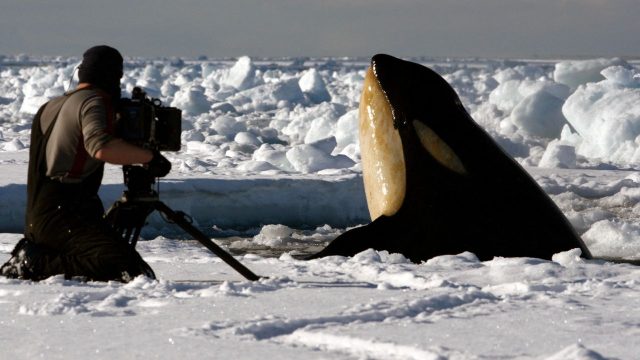
The forbidding landscapes and wildlife of the polar regions get the glowed-up documentary treatment in the BBC’s “Frozen Planet.” David Attenborough narrates for the BBC, but the American version released on the Discovery Channel was recut with voice work by Alec Baldwin. Episodes follow animals like polar bears through multiple climatic seasons and the series is full of awe-inspiring observations about the critical importance of the region to the Earth’s general health — like the fact that a third of the trees on the entire planet exist in the circumpolar belt called the Taiga. “Frozen Planet” is “gorgeous to behold: lump-in-throat, tear-in-eye beautiful,” said Robert Lloyd at the Los Angeles Times, “made to reveal a world few people will ever see.” (HBO Max)
‘Wonders of the Universe’ (2011)
A series “presented by the incongruously boyish and immediately watchable Professor Brian Cox,” this BBC production is meant to show us “just how insignificant our little solar system is when presented with the enormity of space and time indefinite,” said Luke Holland at Den of Geek. Cox’s “deft ability to simplify a concept without patronizing an audience” results in a “profound triumph.” The four-part series tackles the origins of the universe, the pivotal role of stardust in all living things and the nature of space-time, among many other cosmic mysteries. Buoyed by sharp special effects and meditative insights, “Wonders of the Universe” is gripping television. (Prime)
‘Africa’ (2013)
This is yet another stellar series from the BBC, coproduced with the Discovery Channel and narrated by the extremely prolific Attenborough, who turns 100 on May 8 this year and is still working. The six episodes of “Africa” each look at one of the continent’s regions, starting with a tour of the forbidding Kalahari and Namib deserts and traveling through the Congo Basin, the southern tip of the continent and the savannahs of East Africa. Forest Whitaker deftly presents the series in the U.S. market. The series “abounds in jaw-dropping visuals on a scale that, like the best fictional dramas, infuses the epic with the up-close-and-personal,” said Sheri Linden at The Hollywood Reporter. (HBO Max)
‘The Hunt’ (2015)
Viewers might want to steer little kids out of the room before pressing play on BBC’s “The Hunt,” which takes a long look at the dance between predator and prey in different kinds of environments, like grasslands and coasts. It is not ideal for people who are sensitive to violence and gore, but it is riveting. Some cherished illusions will be shattered, including what chimpanzees eat, which is not exclusively fruit but sometimes other, weaker primates like red colobus monkeys. If you can stomach it, “The Hunt” is full of such revelations, rendered lovingly and narrated by (who else?) David Attenborough. “The footage is truly extraordinary and gorgeous, and, for the most part, artfully edited,” said Ken Tucker at Yahoo Entertainment. (HBO Max)
‘Our Planet’ (2019-2023)
You’ll never guess who narrates this Netflix production about habitat loss and the consequences of human encroachment on the natural world. Attenborough, well into his 90s when the series was shot, did some of the best voiceover work of his long career here. The series’ 12 episodes across two seasons visit a dizzying array of locales, from the Congolese rainforest to the Arctic, where polar bears are struggling to adapt to climate change and the loss of their icy homes. A series that “plays notes of an elegy,” it also “contains the saddest scene perhaps ever shot in a nature documentary,” depicting an “enormous gathering of walruses that have been forced onto a tiny stretch of dry land due to the shrinking sea ice in the Arctic,” said Brian Resnick at Vox. (Netflix)
From climate change to the cosmos, many of the greatest nature documentaries have one thing in common: their narrator