
The seemingly limitless budgets and bottomless demand for content of the streaming television era have allowed studios to dramatize both long-ago and recent disasters. These might never have gotten the Hollywood treatment a generation ago, ushering in a little-noticed golden age of disaster television headlined by these eight series.
‘Tsunami: The Aftermath’ (2006)
The 2004 Indian Ocean Tsunami was by far the deadliest natural disaster of the 21st century, and one of the worst in recorded history, killing more than 227,000 people. Much less well-known than the 2012 film “The Impossible,” HBO Max’s “Tsunami: The Aftermath” is gripping viewing.
Ian Carter (Chiwetel Ejiofor) is a tourist in Thailand who searches for his missing wife and daughter after the wave strikes, while Tim Roth plays Nick Fraser, a journalist reporting on the almost unfathomable human loss who begins to wonder why his bosses want information about Westerners but not about the much more widespread local casualties and devastation. The “first-rate cast” also includes Toni Collette and a pre-Downton Abbey Hugh Bonneville. The series depicts the aftermath of the disaster, showing that “in death, human lives develop very different values to different communities,” said Virginian Heffernan at The New York Times. (HBO Max)
‘Chernobyl’ (2019)
HBO’s riveting, five-part dramatization of the 1986 Chernobyl nuclear disaster richly deserved its 10 Emmy Awards. Jared Harris is superb as Soviet nuclear scientist Valery Legasov, who helps convince apparatchik Boris Shcherbina (Stellan Skarsgard) that the situation is sufficiently grave that it can’t be covered up.
The series recreates ordinary Soviet life from the period with painstaking detail and spares no one and nothing in its criticisms of what led to the disaster and how it was handled. The superb ensemble includes Lyudmilla Ignatenko (Jessie Buckley) as the wife of a firefighter mortally wounded in the initial hours of the disaster and the fictional Ulana Khomyuk (Emily Watson) as a scientist who warns political leaders about the consequences of inaction. Chernobyl remains, thankfully, history’s worst nuclear disaster. Though the series takes many creative liberties with history, it “gets a basic truth right — that the Chernobyl disaster was more about lies, deceit and a rotting political system than it was about bad engineering or abysmal management and training,” said Henry Fountain at The New York Times. (HBO Max)
‘Five Days at Memorial’ (2022)
Hurricane Katrina, which killed 1,833 people in August 2005, remains one of the most under-dramatized disasters in memory. Perhaps audiences aren’t ready to confront it yet, much like the Covid-19 pandemic that remains without a significant dramatization.
One exception is the Apple TV+ drama “Five Days at Memorial,” which recreates the events at Memorial Medical Center in New Orleans. Dr. Anna Pou (Vera Farmiga), Karen Wynn (Adepero Oduye), and Susan Mulderick (Cherry Jones) give viewers the perspective of a doctor, a nurse and an administrator at the hospital, which quickly loses power and access to clean water as the disaster gathers momentum. Framed by a post-hurricane investigation into the deaths of 45 patients at the hospital, the eight-part series is a “gripping affair, an engrossing medical thriller that doubles as a powerful indictment of government and corporate inaction and outright neglect,” said Manuel Betancourt at A.V. Club. (Apple TV+)
‘High Water’ (2023)
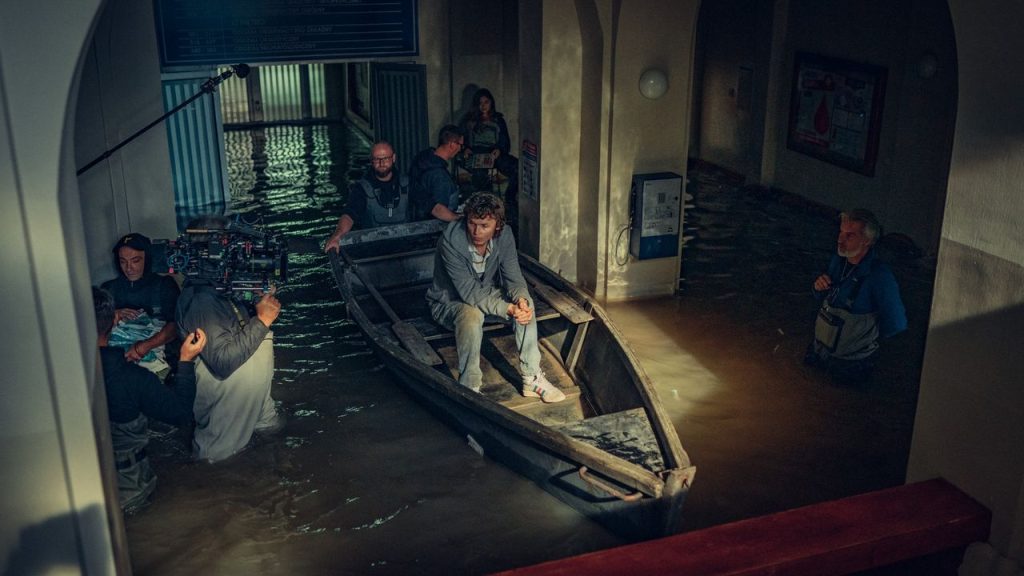
Disasters: They happen everywhere! In July 1997, parts of Poland, Germany and the Czech Republic were struck by catastrophic river flooding that left more than 100 people dead. “High Water” tells the story of the Polish city of Wrocław, the country’s third largest city, which was completely inundated by floodwaters.
Fictional hydrologist Jasmina Tremer (Agnieszka Zulewska) is stuck with the unenviable task of convincing the provincial bureaucrat Jakub (Tomasz Schuchardt) and other officials that disaster is imminent, especially given that they all seem more focused on ensuring a successful visit from the Pope than on preventing tragedy. The series takes its time getting to the main event, building tension and sympathy for its characters before plunging them into ruin. A “character-driven ensemble” carries the show that despite the heavy subject matter, “doesn’t slip into the realm of soapy drama,” said Greg Wheeler at The Review Geek. (Netflix)
‘The Days’ (2023)
No less harrowing than “Chernobyl” is “The Days,” an eight-part dramatization of the Fukushima-Daichi nuclear disaster following the catastrophic 2011 earthquake and tsunami in Japan. Unlike its better-known counterpart, “The Days” is a much more faithful rendition of events, beginning with the earthquake-driven tsunami that inundated the plant and knocked its power offline.
The series is told from three perspectives, including the fictional Prime Minister Shinji Azuma (Fumiyo Kohinata), the power plant’s courageous manager, Yoshida (Koji Yakusho), and several workers who risked their lives to prevent the worst-case scenario from taking shape. The series takes “great pains to include every relevant number, fluctuating dial and horrifying factoid,” said Jonathon Wilson at Ready Steady Cut, and its “ability to ratchet up tension through its rapidly worsening disasters and complexifying circumstances is often profound.” (Netflix)
‘La Palma’ (2024)
The only show on our list that isn’t based on a true story is the Norwegian series “La Palma,” which depicts a mega-tsunami triggered by the eruption and collapse of a volcano in the Canary Islands. Loosely based on a controversial hypothesis, the show is built on familiar but very well-executed beats.
Fredrik (Anders Baasmo Christiansen), his wife, Jennifer (Ingrid Bolso Berdal), and their children, Tobias (Bernard Storm Lager) and Sara (Alma Gunther), are tourists caught up in the disaster, while Marie (Thea Sofie Loch Naess) and Haukur (Ólafur Darri Ólafsson) are scientists who try and fail to warn the authorities that disaster is about to strike. Norway has quietly produced some of the best disaster films of the century, including 2015’s “The Wave” and “La Palma” fits squarely in that tradition. The “relatively small main cast and a lack of melodrama make the show worth a watch,” said Joel Keller at Decider. (Netflix)
‘Every Minute Counts’ (2024-2025)
On the morning of September 19, 1985, a massive earthquake struck the megalopolis of Mexico City, killing about 10,000 people and leveling large swathes of the city. We see the tragedy through the eyes of several ordinary people, including Ángel Zambrano (Osvaldo Benavides), an obstetrician who helped evacuate dozens of newborn babies from a collapsing hospital, a TV reporter, Camila (Maya Zapata), and Chuy (Olaff Herrera) her cameraman.
A show that “can be exhausting to watch,” it is also an indictment of the authoritarian regime that governed Mexico at the time, depicting the consequences of “decades of government corruption that led to unenforced building codes,” said Melissa Camacho at Common Sense Media. “Every Minute Counts” is also the only listed series that was granted a second season, which was released in September 2025 and follows the surviving protagonists as the post-earthquake hours take shape. (Prime Video)
Tsunamis, earthquakes, hurricanes and nuclear meltdowns highlight the most effective depictions of disaster on screen