
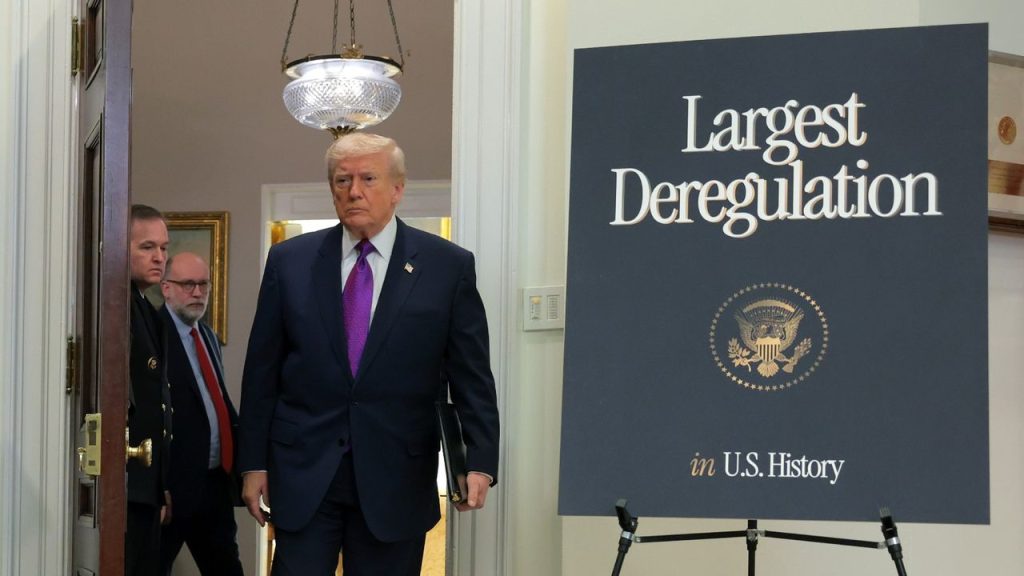
While Republicans have generally been associated with deregulation since the 1970s and 1980s, President Donald Trump has overseen a stratospheric rise in deregulatory policies during his second term. The White House argues these deregulations are about eliminating the red tape of Washington, but critics are worried about Trump’s rolling back of protections.
‘Unleashing Prosperity Through Deregulation’ executive order
Just days after Trump took office again, the White House enacted perhaps its most consequential policy regarding deregulation. Trump’s Executive Order 14192, titled “Unleashing Prosperity Through Deregulation,” established a 10-to-1 rule for federal agencies; it ordered that anytime an agency enacted a “new regulation, it shall identify at least 10 existing regulations to be repealed,” according to the order. The goal of the rule is to “alleviate unnecessary regulatory burdens placed on the American people.”
The EO, beyond establishing deregulatory guidelines, “also requires more upfront disclosure of forthcoming rules,” said Forbes. The order led to a slew of actions being taken by federal agencies and also stated that all new regulations should have no cost. This is “effectively impossible to accomplish when issuing any regulation at all, as nearly every regulatory change represents some level of cost to come into compliance,” said the Economic Policy Institute.
Global warming deregulation
Trump has worked to repeal several factors of the country’s standing on climate policy, most notably the repeal of a 2009 finding, which “focused on emissions from motor vehicles but later regulations of carbon dioxide emissions from power plants and methane emissions from oil and natural gas operations are based on it as well,” said the Brookings Institution. The repeal removed a “key federal tool for reducing greenhouse gas emissions and moving the United States toward a greener economy.”
White House officials say that “overturning the regulation will save more than $1 trillion and will help cut the price of energy and transport,” said BBC News. Environmentalists don’t seem to buy this argument. The deregulation is “going to force Americans to spend more money, around $1.4 trillion in additional fuel costs to power these less efficient and higher polluting vehicles,” Peter Zalzal from the Environmental Defense Fund told BBC News. At least 24 states are suing the Trump administration over the 2009 repeal.
Workplace safety
Throughout its first year back in office, the Trump administration aimed to “rewrite or repeal more than 60 ‘obsolete’ workplace regulations, ranging from minimum wage requirements for home healthcare workers and people with disabilities to standards governing exposure to harmful substances,” said The Associated Press. The changes also applied to workers in other high-risk industries, including those in mines, and would “limit the government’s ability to penalize employers if workers are injured or killed while engaging in inherently risky activities.”
Many labor rights organizations lambasted the move. The deregulation “indicates a readiness to compromise the health and lives of workers, especially Black and brown workers who are overrepresented in the blue-collar industries that would be impacted, in pursuit of corporate profits,” said the Center for Law and Social Policy. Despite the pushback, the government maintains the slashes will “cut regulatory burdens, spur job creation and fuel economic opportunity for American workers and businesses,” said the Department of Labor in a press release.
Commercial fishing
Trump, in another bit of climate-related deregulation, signed a proclamation to restore commercial fishing “within three of America’s marine national monuments in the Pacific Ocean, rolling back protections for areas that are considered pristine ocean ecosystems,” said USA Today. The proclamation expanded the legal commercial fishing area to “about half a million square miles in the Pacific,” with the White House saying the move is “aimed at boosting the U.S. fishing industry and lowering seafood prices for consumers.”
The deregulation has many worried about fish health, especially because Trump is also a big promoter of ocean mining. The move also came as the Trump administration shut down the Ocean Observatories Initiative, which involved the “decommissioning of a vast network of ocean floor sensors that collect data on marine ecosystems, ocean currents and global climate data,” said Truthout. The White House is ultimately “ developing the ocean for offshore oil drilling and mining — basically, as a gas station and a garbage dump,” ocean policy expert David Helvarg told Truthout.
Nuclear power
The White House also turned its crosshairs toward some of the alleged red tape around nuclear energy. The Trump administration “overhauled a set of nuclear safety directives and shared them with the companies it is charged with regulating, without making the new rules available to the public,” said NPR. These changes were implemented to “accelerate development of a new generation of nuclear reactor designs.”
Energy experts cautioned that nuclear deregulation comes with safety risks. The White House is “taking a wrecking ball to the system of nuclear safety and security regulation oversight that has kept the U.S. from having another Three Mile Island accident,” Edwin Lyman, director of nuclear power safety at the Union of Concerned Scientists, told NPR. The nuclear free rein is “yet another example of the Trump administration’s push to accelerate nuclear energy, albeit through unconventional methods,” said Reason magazine.
Financial services
Trump has taken aim at the banking industry as a major arm of his deregulatory platform. With Trump’s authority, financial services regulators are “undertaking the biggest overhaul of bank supervision since the 2008 financial crisis,“ said Reuters. These regulators argue that less stringent policies are needed because banks have “become too preoccupied with processes and pursuing minor issues, and should focus on core financial risks.”
The president himself has also “personally complained that banks have hidden behind reputational risk management to deny services to conservatives, claims they deny,” said Reuters. Financial experts say rolling back these regulations has weakened the banking industry’s power to “police problems that do not inherently amount to material financial risks, but which may eventually lead to problems — such as control lapses, governance or other process issues.”
Governmental powers
All of the deregulations point to a general withering of the federal government. The White House’s “structural deregulation” approach “aims to compromise the capacity of the federal government to fulfill its core functions,” said Lawfare. Within weeks of retaking office, Trump went on a federal deregulation push “more sweeping in scale and scope than what we anticipated and far beyond what the president tried to do in his first term.”
Trump’s “structural deregulation” is “distinct from standard, ‘run-of-the-mill’ deregulation that aims to weaken or rescind certain agency rules or policies but falls short of a wholesale attack on agency capacity,” said Lawfare. Rather, Trump’s agenda includes “regulatory rollbacks that weaken health, safety, financial or labor standards.” Trump’s executive orders have also played a role, most notably Executive Order 14215, which applies the “White House regulatory review process to independent agencies,” said The Regulatory Review, a change that has not historically been implemented.
His administration has ordered each new regulatory change to be accompanied by 10 deregulatory changes