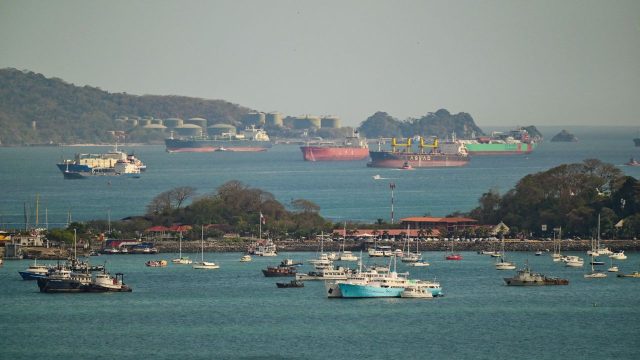
Much has been made of the closing of the Strait of Hormuz during the Iran war, given that the passage is a major lifeline for the global economy. But it is just one of five major waterways that play a significant role in world trade — several of which have their own history of conflicts.
Panama Canal
As the only entry in this list located in the Americas, the Panama Canal serves as a vital waterway for one main reason: it connects the Atlantic and Pacific Oceans. This shortcut lets ships “avoid the lengthy and hazardous voyage around Cape Horn at the southern tip of South America,” said the International Trade Administration. Not forcing ships to circumvent an entire continent “contributes to the reduction of carbon emissions and helps mitigate the environmental impact of global maritime transportation.”
President Donald Trump has pushed for the U.S. to gain full control of the canal, but the “facts are that Panama has managed the canal incredibly well,” said the Harvard Kennedy School of Government. The “revenues generated by the canal are important for Panama, representing about 4% of their GDP. They represent less than 1/10,000 of the U.S. GDP.”
Strait of Hormuz
The strait, which cuts between Iran, the United Arab Emirates and Oman, is one of the “world’s busiest oil shipping channels,” said BBC News. It is used by almost all of the world’s major oil companies, and in 2025, about “20 million barrels of oil and oil products passed through the Strait of Hormuz per day,” equivalent to nearly $600 billion of energy production per year.
The recent closure of the waterway could impact more than just gas prices, as the strait is also a “vital channel for imports to the Middle East, including food, medicines and technological supplies,” said BBC News. If it is not reopened soon, the ripple could “go far beyond the region, affecting energy markets, maritime transport and global supply chains,” said the U.N. Conference on Trade and Development.
Strait of Malacca
Like the Panama Canal, the Strait of Malacca in Southeast Asia serves as a passage between two oceans: the Indian and the Pacific. It represents “one of the most strategically, economically and politically significant maritime chokepoints in the world,” said the National Bureau of Asian Research. The strait is important to the nations around it as well as “great powers with interests in the Indo-Pacific.”
But climate change is leading to “increasing heavy rainfall and extreme flood heights” around the strait, said a study from World Weather Attribution. This could threaten the strait’s “densely populated regions,” particularly near heavily populated countries like Sri Lanka.
Suez Canal
The Suez Canal is the “only place that directly connects the waters of Europe with the Arabian Sea, the Indian Ocean and the countries of the Asia-Pacific,” said CNN, making it an essential waterway for cargo. If the canal didn’t exist, ships in the region would have to “traverse the entire continent of Africa, adding hefty costs and substantially extending their journey times.”
An example of the canal’s importance was seen in 2021, when a cargo ship became stuck across the waterway, cutting off the shipping lane. Any disruptions “can have outsized impacts on global commerce and energy markets,” said the Atlantic Council, given that over $1 trillion goods are transported through the Suez annually.
Turkish Straits
The two Turkish Straits hold “strategic importance as the only waterway connecting the Black Sea to the Mediterranean Sea,” said Turkey’s Ministry of Foreign Affairs. But crossing these two straits, the Dardanelles and the Bosphorus, is not easy, as “strong currents, sharp turns and unpredictable changes in weather conditions make it all the more difficult to navigate safely.”
During a war, the straits also become vital due to a 1936 treaty regulating their passage, which “states that, at times of conflict, ‘vessels of war belonging to belligerent powers shall not pass through the Straits,’” said Arab News. The implication of this treaty has often demonstrated Turkey’s “ultimate say over any warship if it deems its movement to be a security threat.”
These waterways act as a lifeline for much of the world’s economy