Israel’s famed Iron Dome air defence system is the envy of many around the world – and may eventually have a copycat in Taiwan.
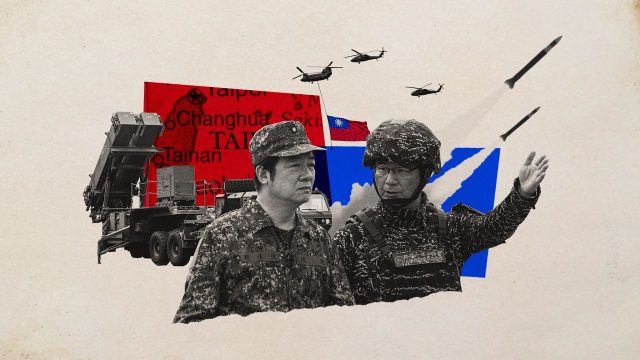
The president of Taiwan has announced a “historic” $40 billion increase to the defence budget over the next eight years, which he says would include a “T-dome” air defence system. That would be accompanied by artificial intelligence, drones and other hi-tech equipment to boost Taiwan’s “asymmetric” defence against a Chinese attack.
President Lai Ching-te, writing in The Washington Post, blamed China’s “unprecedented military build-up”, its “intensifying provocations” in the region and “record” army incursions into Taiwan’s vicinity. Beijing’s “willingness to alter the status quo by force has become increasingly evident”, he said.
Tensions over Taiwan
Tensions are mounting over the self-governing democracy, which Beijing still considers Chinese territory. Xi Jinping has repeated his desire to “reunify” the island with China. Since Lai labelled China a “foreign hostile force” in March, China’s People’s Liberation Army (PLA) has been conducting large-scale military exercises around the island.
China and Japan are also locked in an escalating row over Taiwan. The new Japanese prime minister Sanae Takaichi suggested last month that her country could respond with its own self-defence force if China attacked Taiwan.
Last week, Taiwan’s defence ministry said that Chinese military harassment had become a “severe security challenge” that Taiwan must meet. Equipped with “multi-layered defence, high-level detection and effective interception”, the T-Dome would “weave a safety net” to protect citizens, Lai said.
“Taiwan must not become a weak point in regional security,” he said at a news conference. “Among all the possible scenarios for China’s annexation of Taiwan, the biggest threat is not force – it is our own surrender.”
US military experts believe President Xi has told the PLA to “develop the capability to attack Taiwan by 2027”, said the Financial Times. The planned missile defence system would likely be used to protect the island in case of invasion, or against “targeted strikes calibrated to force Taiwan to negotiate without triggering a military response from the US”.
Taiwan’s defence spending has already doubled in recent years. The increased funding is part of a plan to raise spending from 2.5% to 3.3% of GDP by next year, and 5% by 2030, in response to “demands from the Trump administration” not to rely on the US for help, said The Times.
American pledges to defend Taiwan against a Chinese invasion “have always been deliberately ambiguous”, but Joe Biden “stated clearly that he expected the US to come to Taiwan’s aid”. Donald Trump’s re-election, however, “cast doubt on the security of the relationship”. His administration has offered “conflicting signals” on whether it regards China as a threat, while the isolationism of the Maga movement “challenges the whole notion of overseas interventions”.
Domestic opposition
Lai still has to get the supplementary budget approved by Taiwan’s parliament. That is controlled by the opposition party Kuomintang (KMT) – which is closer to Beijing – in alliance with the third party, the Taiwan People’s Party.
And defence has “become a polarising subject”, said the BBC. “Lai’s opponents accuse him of using the fear of a Chinese invasion to shore up his support, and urge more diplomacy with Beijing.”
Hsu Chiao-hsin, a Kuomintang politician, called the planned budget “astronomical”, said The Washington Post, and questioned whether it would “turn Taiwan into a wartime state”. Cheng Li-wun, the new KMT leader, accused Lai of “playing with fire”, said The Times.
Some Taiwanese military analysts also criticised the plan, calling it impractical and inadequate against China’s superior firepower. “If the system is modelled after Israel’s, it will require a massive budget. It won’t be easy,” said political scientist Hung-Jen Wang of the National Cheng Kung University.
It would take longer than the remainder of Lai’s term to build the dome, said Dennis Weng of the Sam Houston State University. That suggests there is a “promotional intent” and that the message is “clearly aimed at the US”.
China responded with predictable aggression; its foreign ministry said Taiwan would “never succeed” in its attempts to resist reunification.
President announces historic increase in defence spending as Chinese aggression towards autonomous island escalates