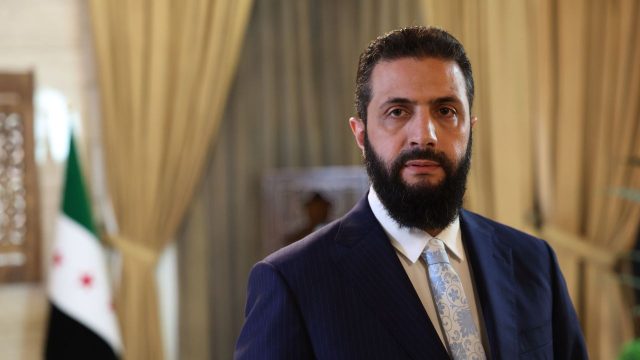
Syria is at a “major turning point”, said Noura Doukhi in L’Orient-Le Jour (Beirut). When the current president Ahmed al-Sharaa, the former leader of the Islamist group Hay’at Tahrir al-Sham (HTS), ousted the dictator Bashar al-Assad in December 2024 after 13 years of civil war, he inherited a country splintered into different spheres of control. The most formidable of these was Syrian Kurdistan, known as Rojava – a semi-autonomous territory in the northeast run for more than a decade by Kurdish-led groups.
But, in one of his “biggest strategic victories” since Assad’s fall, Sharaa has now captured most of the region. Following a lightning offensive by Damascus, the Kurdish-led Syrian Democratic Forces (SDF), a US-backed militia that helped to defeat Islamic State, had little choice but to sign a 14-point deal on 18 January. It required them to cede control of the majority- Arab Raqqa and Deir al-Zour provinces, including their lucrative oil and gas fields. The SDF must also disband.
Reversal of fortune
It’s a huge blow for the long-oppressed Kurds, Syria’s largest ethnic minority, who thought “their fortunes had been transformed”, said Matt Broomfield on UnHerd (London). Their “secular, feminist, and nominally direct-democratic” self-rule began in 2012, when Assad’s troops withdrew from Rojava’s heartlands. After seizing Baghuz, Isis’s last stronghold in 2019, the SDF’s territory was the size of Lebanon, stretching from the borders of Turkey and Iraq to the River Euphrates. Even HTS, during its victorious campaign against Assad, couldn’t dislodge them.
Now their dreams of autonomy are over. It took just two weeks for SDF control to unravel, as the government exploited local anger over Kurdish rule in Arab-majority Raqqa and Deir al-Zour. And the SDF’s power is restricted to its strongholds in the northeast and “enclaves” in Kurdish-dominated cities.
The US and its allies look like they’re guilty of “another blatant act of perfidy” against the Kurds, said Con Coughlin in The Daily Telegraph (London). The West first vowed to create a Kurdish homeland after the end of the First World War; it never materialised. Now Syria’s Kurds, the defeaters of Isis, have also been betrayed. The US has “effectively signalled an end” to military support for the SDF, said Al Arabiya (Riyadh). Tom Barrack, the US envoy to Syria, stated last week that the Kurdish force’s anti-Isis role had “largely expired”, and that Damascus was now best placed to enforce security.
True colours
There are already concerns that, as a result, Isis could now “rebound and reorganise”, said Paul Iddon in Forbes (Jersey City). Under the 18 January agreement, Sharaa’s forces are in theory meant to govern many of the jails and camps holding Isis fighters and their families in northeastern Syria. But in the recent chaos, hundreds of militants escaped from al-Shaddadi prison; some also reportedly fled al-Hol, a remote desert camp whose detainees include some 20,000 people with family ties to Isis. Both the SDF and the government have blamed the other side for the escapes.
Perhaps Sharaa is now showing his true colours, said Tanya Goudsouzian in Le Monde Diplomatique (Paris). His campaign against the Kurds belies his promise to respect all Syria’s ethnic minorities. “Despite his clipped beard and British suits”, his troops’ actions “seem more in line with their roots in the terrorist group HTS than those of a new nation committed to democratic oversight and governance”.
Even if Sharaa’s promises are well-intentioned, it’s not clear that he’s got full control over “his patchwork army”, said Christian Vooren in Die Zeit (Hamburg). His forces committed massacres against the Alawites on the coast in March, and there was violence in the Druze-majority Suweida province in the south last summer. What happens next with the Kurds in the northeast is “perhaps the greatest” test of all for the new Syria. At the moment, “the ceasefire is fragile and the situation remains unclear”.
Ahmed al-Sharaa’s lightning offensive against Syrian Kurdistan belies his promise to respect the country’s ethnic minorities