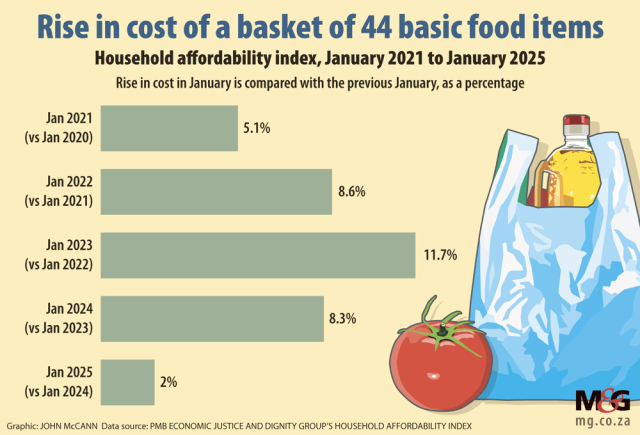
Households living on the minimum wage are struggling to put food on the table because wages are not keeping pace with the rising prices of electricity, transport and groceries.
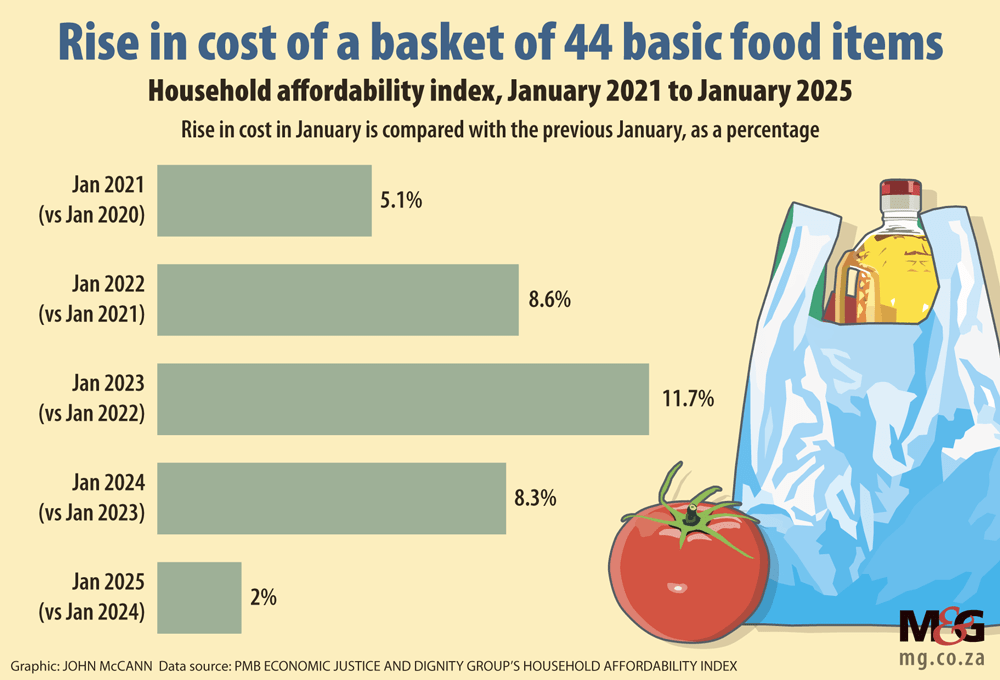
This is according to the Pietermaritzburg Economic Justice and Dignity Group’s Household Affordability Index for January 2025, which shows the average cost of a monthly basket of 44 basic items increased by R108.84 (2%) from R5 324.86 in January 2024 to R5 433.70 this month.
Food prices are tracked directly by data collectors off the shelves of 47 supermarkets and 32 butcheries that target the low-income market and which women identify as key retailers in Durban, Johannesburg, Cape Town, Pietermaritzburg, Springbok and Mtubatuba.
The basket comprises monthly groceries for a family of seven.
According to the report, Cape Town’s food basket increased the most, by R151.36 (2.9%) year-on-year to R5 368.58, followed by Johannesburg, which was up R145.61 (2.7%) to R5 507.38, while the Springbok basket cost rose by R152.58 (2.7%) year-on-year to R5 773.13 this January.
The baskets in KwaZulu-Natal saw the lowest price increases, with Pietermaritzburg decreasing by 3.1% to R5 075.45 from last year, while the Durban basket price ticked up by 1.7% to R5 451.07. Mtubatuba rose 2.4% to R5 600.67.
The cost of core items that households prioritise every month increased by 3.5% to R2 936.63 in January, which is higher than Statistics South Africa’s latest food inflation print of 1.7% (excluding non-alcoholic beverages) for December 2024 and despite the generally lower headline inflation numbers in recent months.
Items in this category that rose above inflation include 30kg maize meal (up 16%), 10kg white sugar (5%), 5kg sugar beans (18%), 5kg samp (9%), 10kg onions (4%) and 250g tea (8%).
“The cost of the foods prioritised and bought first in the household food basket is important. The core foods are bought first and these foods ensure that families do not go hungry while ensuring that meals can be cooked,” the Pietermaritzburg Economic Justice and Dignity Group said in the report.
“When the prices of core foods increase, there is less money to secure other important mostly nutritionally rich foods, which are essential for health and well-being and strong immune systems, such as meat, eggs and dairy. These are critical for protein, iron and calcium.
“Vegetables and fruit, which are critical for vitamins, minerals and fibre; and maas, peanut butter and pilchards, good fats, protein and calcium are essential for children.”
Core foods contribute 54% of the total cost of the household food basket. “These foods are relatively very expensive in relation to the total money available in the household purse to secure food. These foods must be bought regardless of price escalations,” the report stated.
“The high cost of core staple foods result in a lot of proper nutritious food being removed off the family plates. The consequences of high costs on the core foods has a negative impact on overall household health and well-being, and child development.”
The cost of the household domestic and personal hygiene basket increased by 4% from R1 005.81 in January 2024 to R1 045.64 this month.
“The money needed to secure domestic and personal hygiene products is sourced from within the food budget. These products compete viciously in the food budget,” the Pietermaritzburg Economic Justice and Dignity Group said.
Twenty-two food items in the overall basket attracted VAT amounting to 6.1%, or R331.02 of the cost of the basket. This was nearly the same as a large household’s requirement of 30kg of maize meal a month at R341.39.
The report also highlights that the cost of a basic nutritional food basket for a family of seven members — including items families should buy if they were able to afford them — increased by R146.92 (2.2%) year-on-year to R6 686.86 this January.
“In January 2025 the difference in cost between the foods which families living on low incomes try to buy each month (the household food basket) and the foods which families would like to buy and should buy to meet basic nutrition (a basic nutritional food basket) was R1 253.16,” the report said.
“This means that in January 2025, families with seven members underspent on basic nutritional food by a minimum of 19%.”
Many low-income households relying on a national minimum wage earner are not able to afford even the basic household food basket. This is despite a 8.5% wage increase on 1 March 2024, which gave workers an extra R2.16 an hour, taking the hourly rate to R27.58 and translating to a R362.88 monthly increase.
“The national minimum wage is a poverty wage — it hurts workers, it reduces productivity in the workplace and slows down economic growth. The minimum wage of R4 854.08 in January 2025 when disbursed in a family of four persons is R1 213.52. This is below the upper-bound poverty line of R1 634 per capita per month,” the report said.
“Set at such a low level, the national minimum wage works to institutionalise the low-baseline wage regime and lock millions of workers into poverty.
“Small annual increments off such a low wage base, and which do not reflect inflation levels as experienced by workers, nor the actual cost of worker expenses (including not projecting inflation forward for workers in the entire 2024-25 term), means that workers on minimum wage are getting poorer and poorer each year.”
Using calculations based on Pietermaritzburg and the average cost of a minimum nutritional basket of food for a family of four, electricity and transport consume 57.7% of a worker’s wage, leaving just R2 051.11 for groceries. This translates to a shortfall of 46.4% to be able to afford the basket.
“In this scenario there is no possibility of a worker being able to afford enough nutritious food for her family. If the entire R2 051.11 all went to buy food, then for a family of four persons, it would provide R512.78 per person per month. This is below the food poverty line of R796,” the report said.
The indication of a large portion of income being spent on electricity and transport is in line with the latest StatsSA income and expenditure survey of 2022-23 released this week.
It showed that South Africa’s total annual household consumption expenditure from November 2022 to November 2023 was about R3 trillion.
The main components of household consumption expenditure were housing, water, electricity, gas and other fuels, food and non-alcoholic beverages, transport and insurance, and financial services.
“These top four main components of household consumption expenditure divisions account for approximately three-quarters (75.6%) of all household consumption expenditure in the country, StatsSA said.
“Essentially, three out of every four rands spent by South African households goes towards these four key areas.”
The average annual consumption expenditure for households was R143 691 in 2023, according to the report. The median was R82 861 a year.
National minimum wage earners can’t afford sufficient nutritious food to feed their families